
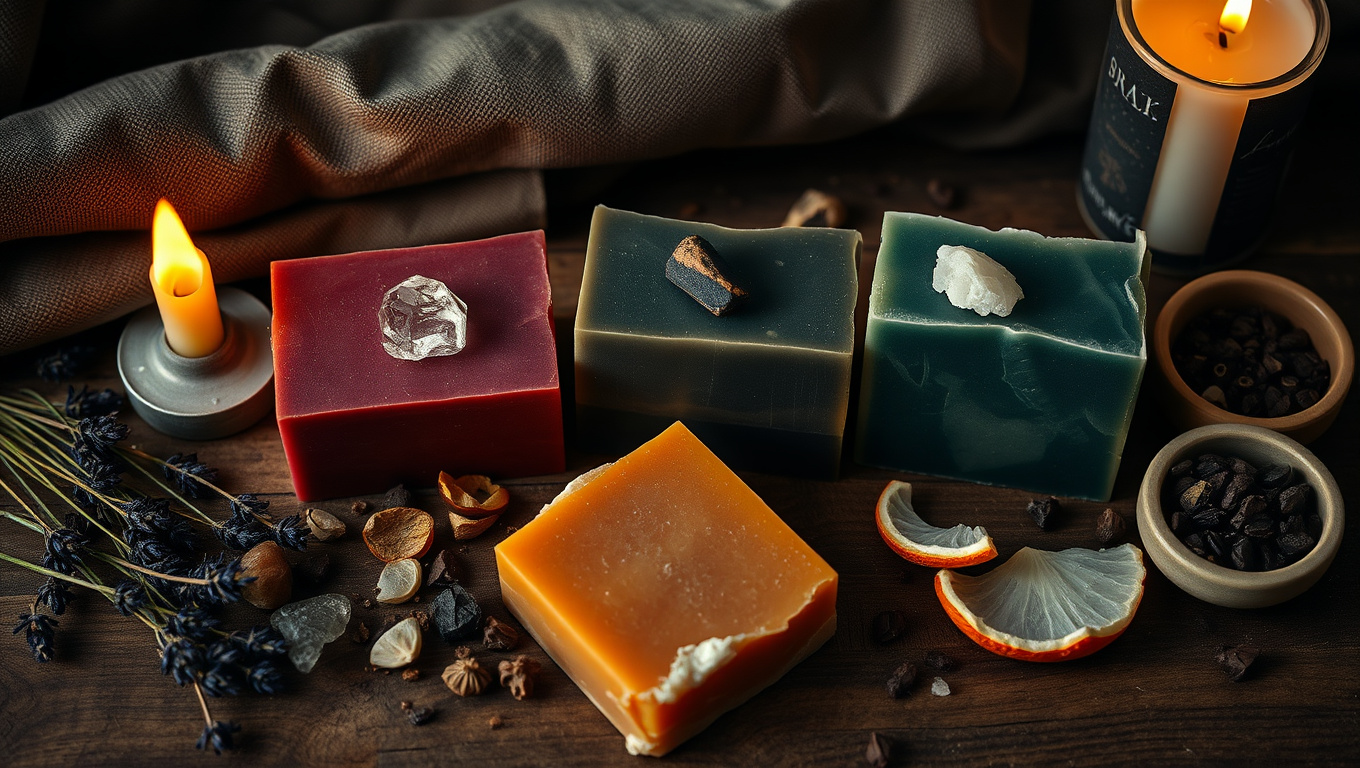
Where Every Bar Begins: The Craft Behind Handmade Witch Soap
There is a particular moment in soapmaking — somewhere between measuring and mixing — where the whole thing starts to feel like something more than chemistry. The oils warm in the pot. A fragrance lifts into the air. You pour, and something shifts. Every bar of handmade witch soap from Spellbound Grove is born in that moment. Not in a factory, not on a conveyor belt, but in a small-batch process that takes time, precision, and genuine care.
People often ask what makes handcrafted soap different from what you find wrapped in plastic at a big box store. The honest answer involves both craft and ingredients — but it also involves intention. When you make soap in small batches, you can pay attention. You can choose your oils thoughtfully, blend your scents with purpose, and press a real crystal into the top of a bar while it’s still soft enough to hold it. That is not something a machine does.
This is a look at how it actually works — from the raw materials on the workbench to the cured bar sitting in your hand. No mystification, no exaggeration. Just the real, quietly enchanting process of making a ritual soap bar by hand.
The Foundation: Oils, Butters, and What They Bring to a Bar
Soap, at its most fundamental, is the result of a chemical reaction between fats and an alkali — typically lye, which is sodium hydroxide in its solid form. This reaction is called saponification. When it completes fully, no lye remains in the finished bar. What you are left with is soap, glycerin, and whatever qualities the original oils contributed.
That last part matters more than most people realize. Different oils behave differently in a finished bar of soap. Some create a hard, long-lasting bar. Some build a rich, dense lather. Some leave the skin feeling softer after rinsing. Soapmakers who care about their craft choose their oil combinations deliberately, balancing these qualities against one another the way a baker balances flour, fat, and liquid in a dough.
Why Oil Choice Shapes Everything
Coconut oil, for instance, is a workhorse in cold-process soapmaking. It contributes hardness and produces a bubbly, cleansing lather. But used alone, it can be drying, so it is almost always paired with oils that counterbalance it — things like olive oil, which has a long history in handmade soap and contributes a gentler, creamier quality to the bar. Castor oil, even in small amounts, boosts lather and helps bind a fragrance blend.
Shea butter and cocoa butter are popular additions in natural soap bars because they contribute both hardness and a richness that the lather carries onto the skin. These are the kinds of decisions made before a single batch is poured — the invisible architecture beneath the finished bar.
At Spellbound Grove, these choices are made with the finished ritual experience in mind. A bar meant for a moonlit bath should feel different from one meant for a brisk autumn cleansing. The oil blend is where that intention starts.
The Lye Process: Honest About the Chemistry
Lye tends to make people nervous, and it deserves respect. Sodium hydroxide is caustic in its raw state, and working with it requires proper safety precautions — gloves, eye protection, careful measuring, and good ventilation. This is not something to minimize. It is also not something to fear unnecessarily, because when saponification is complete, the lye is gone. Every cold-process soap bar you have ever used — commercial or handmade — was made with it.
The lye is dissolved into a liquid, typically water, though some soapmakers use milk, tea, or botanical infusions as part of their liquid component. This is one of the places where a small-batch maker can add real character to a recipe. A chamomile tea base, for instance, brings something different to the finished bar than plain water — not a medical claim, just a sensory and craft distinction that mass production simply cannot accommodate.
Cold Process vs. Hot Process: A Quick Distinction
Most of the bars at Spellbound Grove use the cold-process method, which means the oils and lye solution are combined at relatively low temperatures and the saponification reaction happens slowly, on its own, over time. This preserves the scent of delicate botanicals and fragrance blends more effectively than hot-process methods, where external heat is applied to speed the reaction. Cold process takes more patience — and significantly more curing time — but the finished bars tend to have a smoother texture and a more complex scent profile.
Hot process soap has its place, and some makers prefer it for certain recipes. But when you are building a ritual soap around something like cypress and clary sage, or myrrh and jasmine, you want the cold process. You want those notes to survive.
Scent Blending: The Ritual Before the Ritual
This is the part that feels most like witchcraft, honestly.
Blending the scent for a ritual soap is not just about smelling nice. It is about choosing fragrance notes that layer well — top notes that greet you first, middle notes that carry the body of the scent, and base notes that linger on the skin after rinsing. It is also, for a brand like Spellbound Grove, about choosing botanicals and scents that carry meaning in folk tradition and lore.
Reading the Folklore of Fragrance
Patchouli has long been associated in folk practice with grounding and earthiness. Cypress appears across many traditions as a plant of transitions and thresholds — it grows in old cemeteries throughout the Mediterranean, and its association with liminal spaces runs deep in folklore. Myrrh has been burned as incense across cultures for centuries, its thick, resinous scent tied to ritual, reverence, and the sacred.
None of this is invented. These associations come from real human history — from folk herbalism, from religious practice, from the long and layered relationship between people and plants. When Spellbound Grove names a bar after Hecate, goddess of crossroads and keeper of the in-between spaces, the fragrance choices are not random. Hecate’s Feline Friend opens with cypress and lavender, deepens into clary sage and cedarwood, and settles into patchouli — a layered, earthy, softly wild scent that feels appropriate to a deity traditionally associated with moonlit paths and ancient knowing.
Similarly, Dark Alchemy builds a complex blend from myrrh, cypress, lavender, jasmine, rose, patchouli, cinnamon, and black pepper — a scent profile that moves between floral and resinous, warm and sharp. Each note does something. None of them are accidental.
Blending takes time. A scent that smells perfect in the bottle may shift once it meets the lye mixture, or again once it cures. Experienced soapmakers know which fragrances behave predictably and which ones do unexpected things — accelerating the trace too quickly, fading during cure, or morphing into something entirely different after six weeks in the drying rack. It is part science, part accumulated intuition.
Color, Crystal, and the Finishing Touches
Once the scent is blended and the oils and lye solution are combined, the batter is poured. But before it sets, there is still work to do — swirling colors, pressing adornments into the top, dusting with botanicals or mica. This is where a handmade soap becomes unmistakably itself.
Spellbound Grove’s bars often feature a crystal or stone adornment set into the top of the bar. This is not decorative in a superficial sense. It connects the soap to a particular intention, a tradition, a mood. The Moonlit Cauldron bar, for example, carries a piece of white howlite — a stone long associated in folk and crystal traditions with stillness and quiet presence. The bar itself is scented with blackberry, chocolate amber, and Roman chamomile, and that combination of scent and stone gives it a specific, coherent character that a mass-produced bar could never replicate.
Why Small Batches Make This Possible
You cannot press individual crystals into thousands of bars at once. You cannot hand-swirl each one for a unique color pattern. Small-batch production is not just a marketing phrase — it is a physical requirement for this kind of attention. Each pour is a limited run. When a batch sells out, it is gone until the next one is made.
That also means slight variation is natural and expected. Two bars from the same batch may have slightly different swirl patterns. The color at the edge of a bar may differ from the center. These are not flaws. They are evidence that a person made this, not a machine.
The Cure: Patience as an Ingredient
After pouring, handmade cold-process soap needs time. Real time. Most cold-process bars are left to cure for four to six weeks before they are ready to use. During this period, the saponification process finishes completely, excess water evaporates from the bar, and the soap becomes harder, milder, and longer-lasting.
A bar that has not cured long enough is soft, drains quickly in the shower, and may feel harsh on the skin. A properly cured bar holds its shape, lathers well, and lasts. Curing is not optional — it is the part of soapmaking that requires a maker to simply wait, and trust the process.
For a small-batch maker, this means planning ahead by weeks, not days. The bars you order today were likely poured a month or more ago. That timeline is built into every batch, and it is one of the quieter forms of care that goes into a handcrafted soap bar.
Building a Simple Ritual Around Your Soap Bar
You do not need an elaborate altar or a specific moon phase to make a bath feel intentional. Small rituals are often the most sustainable ones — the kind you actually return to, week after week, because they are simple enough to fit a real life.
A Few Ways to Use a Ritual Soap Mindfully
- Choose your bar with intention. Before stepping into the shower or bath, hold the bar for a moment. Notice the scent. Think briefly about what you are washing away — a hard week, a difficult conversation, a season that has worn on you. Let the bar be a small marker of transition between that and what comes next.
- Work with the lather slowly. Cold-process soap builds a different lather than commercial bars — often creamier, sometimes slower. Let it develop. Notice the scent as the steam rises. This is not a rush.
- Keep the crystal. Many Spellbound Grove bars include a stone adornment that will eventually separate from the bar as you use it. Keep it on your windowsill, your altar, or your bathroom shelf. It is a small, tangible reminder of the ritual you built around that bar.
- Match your soap to the season. A warm, spiced bar like Fall Harvest — with apple cinnamon, nutmeg, clove, and frankincense — feels right in a cold-weather bath in a way that a bright floral might not. Seasonal living does not have to be complicated. Sometimes it is just choosing the soap that smells like the time of year you are actually in.
- Try before you commit. If you are new to Spellbound Grove’s bars and not sure where to start, the free soap sample is a low-stakes way to experience the lather, scent, and feel before choosing a full bar. One sample per customer — a genuine invitation, not a trick.
Caring for Your Handmade Soap Bar
Handmade soap lasts longer when it drains and dries between uses. A wooden soap dish or a draining tray makes a real difference. Keep your bar out of standing water. If you are storing extras, a cool, dry place away from direct sunlight is ideal. The scent and quality will hold well that way for months.
What Makes a Handmade Witch Soap Different in the End
It is easy to romanticize the craft, and there is genuine romance in it. But the real difference between a mass-produced bar and a handmade witch soap from a small-batch maker is more practical than poetic: the ingredients are chosen deliberately, the process is slow and hands-on, and no two batches are exactly alike.
There is no automation that decides whether cypress or cedarwood better suits a Hecate-inspired bar. No algorithm chooses to press a piece of clear quartz into the top of a dark alchemy blend. No machine waits six weeks for a bar to cure before it ships. These are human decisions, made by someone who cares about the finished product.
That is what you hold when you pick up one of these bars. The smell of real botanicals, the weight of a properly cured bar, the slight irregularity that proves it was poured by hand. It is a small thing, in the grand scheme. But small things, done with care, have a way of mattering.
Find Your Bar at Spellbound Grove
If you have been curious about what goes into a small-batch ritual soap, I hope this gave you a clearer picture — not just the romance of it, but the actual craft. The measuring and waiting and choosing, the chemistry that happens quietly in a mold over weeks, the moment a finished bar finally goes out into the world.
Every bar at Spellbound Grove is made this way. Thoughtfully, in small batches, with real ingredients and real intention. If you are ready to find a handmade witch soap that fits your practice, your season, or simply your bathroom shelf, browse the handcrafted soaps and botanical bath goods at Spellbound Grove and see what calls to you. There is something for the deep-winter bath ritual, the full moon cleansing, the quiet Tuesday morning that deserves a little more than ordinary.