Where Three Roads Meet: Hecate and the Power of the Crossroads
There is something about a crossroads that stops you in your chest. It is not just the choice of direction — it is the feeling of standing between what was and what might be, with every possibility still open. In ancient Greek tradition, this charged, in-between space belonged to Hecate. And if you have ever found yourself drawn to handmade witch soap adorned with keys, cypress, or the dark shimmer of obsidian, there is a good chance she had something to do with it.
Hecate is one of the most enduring figures in Western magical tradition. She shows up in ancient Greek texts, in Roman religious practice, in medieval grimoires, and in the quietly thriving world of modern witchcraft. Makers who craft botanical bath goods, ritual candles, or small-batch soaps often return to her again and again — not because she is trendy, but because something in her story keeps being true. She is the goddess of thresholds. Of transitions. Of the kind of wisdom that only comes from having walked through hard things and kept walking.
This piece is about why she endures. Why her symbols still find their way onto handcrafted soap bars and into the rituals of people who have never set foot in ancient Greece. And what it actually means to make something — or use something — in her name.
Who Was Hecate? A Brief and Honest Look at the Lore
Hecate’s origins are genuinely ancient. She appears in Hesiod’s Theogony, one of the oldest surviving works of Greek literature, where she is described as a powerful and honored figure who could bestow or withhold blessings from humans across sea, land, and sky. That triple domain is significant — she was never confined to one realm. She moved between worlds, which is part of what made her both respected and a little unsettling to those who preferred their gods to stay in their lane.
Over centuries, her mythology deepened and shifted. She became closely associated with the moon, with night, and with the liminal — those threshold moments and spaces that fall between categories. Doorways. Midnight. The turning of seasons. The moment between waking and sleep. She was honored at crossroads, where offerings were left on new moon nights. The image most commonly associated with her is triple-formed: three figures standing back to back, looking out in three directions at once. Some interpretations see this as past, present, and future. Others see it as the three phases of the moon.
She is also famous for her torches and her keys. The torches light the dark road. The keys open what is locked — including, in folk tradition, locked doors between the living world and whatever lies beyond it. Her companions were dogs, and the night-blooming plants of her sacred garden included yew, cypress, and dark herbs associated with the boundary between life and death.
The Triple Goddess Connection
Modern witchcraft often links Hecate to the Triple Goddess archetype — maiden, mother, and crone — though this is largely a twentieth-century framing rather than a direct ancient belief. It is worth noting that distinction. Ancient Greek worshippers did not necessarily understand her that way. But the resonance is real for many modern practitioners, particularly those who are drawn to the crone aspect: the elder who has outlived the need to be palatable, who carries hard knowledge, who stands at the end of things and is not afraid.
That quality — the unafraid witness at the edge — is probably why Hecate speaks so clearly to people going through transitions. Grief. Change. The end of something and the uncertain beginning of something else. She is not a goddess of easy comfort. She is a goddess of honest accompaniment through the difficult parts.
Why Hecate Endures in Modern Witchcraft
The modern witchcraft revival has drawn on many sources — folklore, ceremonial magic traditions, feminist spirituality, folk herbalism, and a general cultural hunger for something more grounded and meaningful than what mainstream consumerism offers. Within that revival, certain figures resonate with particular staying power. Hecate is one of them.
Part of it is her complexity. She does not fit neatly into a single story. She is ancient but not remote. She is associated with darkness but carries torches. She lives at crossroads, which is exactly where most of us feel like we are living at any given moment — between the life we had and the one we are trying to build.
There is also something about her relationship to craft and knowledge. In various folk traditions, she is associated with herbalism, with the preparation of plant-based preparations, with the kind of hands-on, material wisdom that gets passed down through practice rather than texts. Makers — people who actually knead lye and oils together, who press dried flowers into soap molds, who know the difference between how cypress smells fresh-cut versus aged — often feel a kinship with that kind of knowledge. The kind you carry in your hands.
The Crossroads as Ritual Concept
In practical terms, the crossroads in Hecate’s tradition represents the moment of decision, but also the moment of release. Offerings left at crossroads in ancient practice were often acts of letting go — releasing what no longer served, asking for guidance on the road ahead. That is a deeply human impulse. And it maps naturally onto modern ritual practice: the new moon intention-setting, the full moon release, the bath ritual that marks the end of one chapter and the beginning of another.
When a soap maker draws on Hecate’s symbolism — cypress for its deep, resinous green-wood scent long associated with mourning and transition, lavender for its cool, calming presence in folk tradition, patchouli for its earthy grounding quality — they are working in a language that is old but not obsolete. Scent has always been part of ritual. The act of washing has always carried metaphorical weight. To make a ritual soap in Hecate’s name is to bring those threads together in something you can hold in your hand.
Scent, Symbolism, and the Craft of Ritual Soap
Handmade soap is, at its core, a simple thing. Oils. Lye. Water. Time. But the choices made within that simplicity carry meaning. Every ingredient has a scent profile, a texture, a color. Every botanical embedded in the bar has a history — culinary, medicinal in folk tradition, ceremonial. A soap maker working with intention thinks about all of that, and the result is something genuinely different from a mass-produced bar.
The scents associated with Hecate in folk practice are not arbitrary. Cypress has been used in funerary and transitional contexts across Mediterranean traditions for centuries — its sharp, clean, slightly bitter green scent is associated in folk custom with the boundary between worlds. Myrrh, another Hecate-adjacent resin, is among the oldest traded aromatics in human history, with a deep, bittersweet smokiness that has featured in sacred practices across Egypt, Greece, and the ancient Near East. Lavender’s role in folk tradition spans everything from sleep to spiritual protection. Cedarwood grounds and steadies.
When these notes come together in a small-batch handcrafted bar, the soap becomes more than a cleansing product. It becomes a sensory anchor for a particular state of mind — the kind of still, inward attention that ritual asks of us.
Spellbound Grove’s Hecate-Inspired Bars
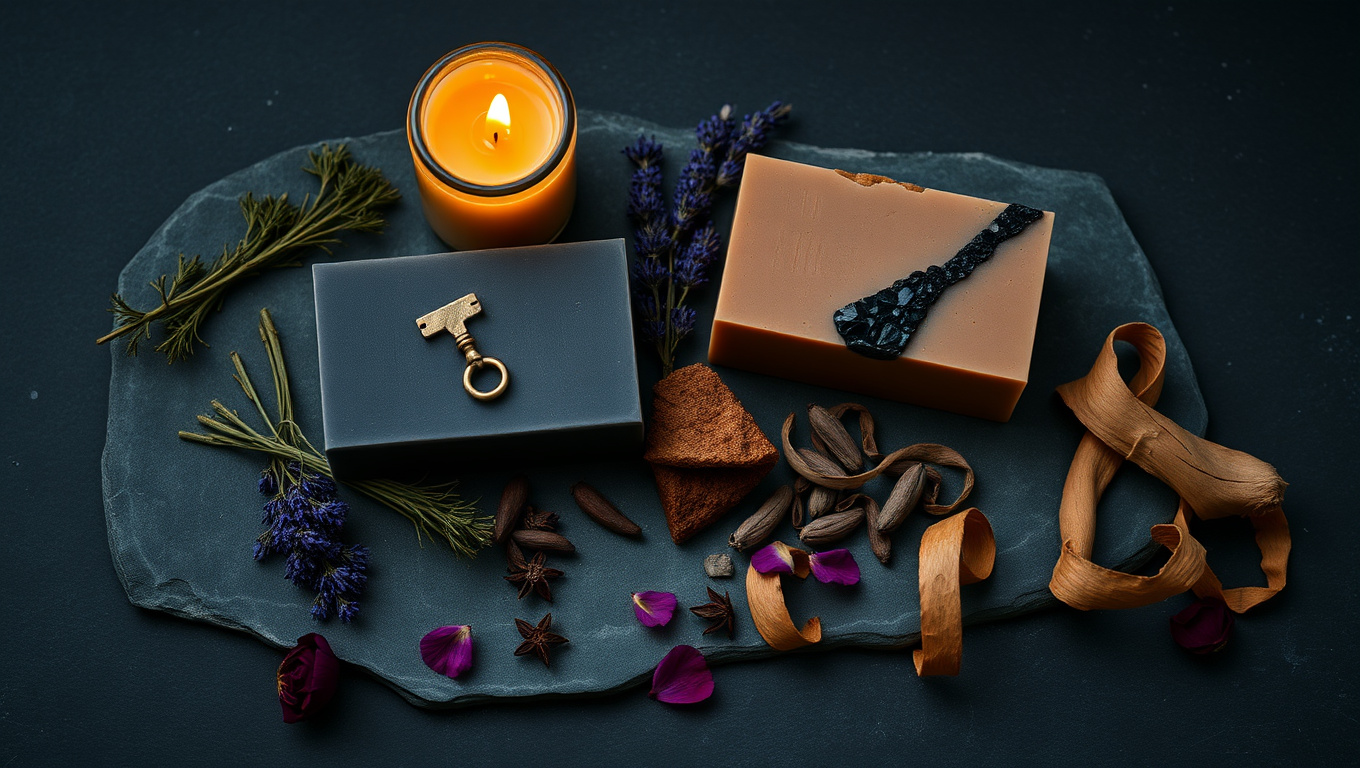
At Spellbound Grove, Hecate’s presence in the workshop is felt in more than one bar. Goddess Hecate Natural Handmade Witch Ritual Bar Soap opens with myrrh and cypress — that dark, rooted combination that seems to belong to crossroads and quiet corners — and layers in lavender, jasmine, and amber, softening toward something warmer and more personal. An antique key rests on top of each bar. It is one of those details that means something when you know the lore, and reads as simply beautiful when you don’t.
Then there is Hecate’s Feline Friend Natural Witch Ritual Bar Soap, which leans into a different facet of the same figure. Hecate in folk tradition was accompanied by animals — dogs most commonly, but cats became associated with her in later European traditions. This bar carries cypress and cedarwood as its backbone, brightened by clary sage and warmed by patchouli, with a grounding quality that suits the kind of slow, quiet rituals you do by candlelight rather than by ceremony.
Both bars are made in small batches, which matters. Small-batch soap develops differently than industrially produced bars — there is more variation, more care in each pour, and the natural glycerin produced during saponification stays in the bar rather than being extracted, as it often is in commercial production. You can feel the difference in how a good handmade bar lathers and how it leaves your skin feeling after.
Building a Simple Hecate-Inspired Crossroads Ritual at Home
You do not need elaborate tools or years of practice to bring a little of this into your daily life. The crossroads ritual, in its simplest form, is about marking a threshold — acknowledging that you are between one thing and another, and choosing how you want to step forward.
A Bath Ritual for Transitions
This works at any moon phase, though the new moon and full moon feel particularly suited. The new moon is traditionally a time for setting intentions — what do you want to call in? The full moon invites release — what are you ready to let go of?
- Before you begin: Tidy the bathroom a little. Not because it has to be perfect, but because the small act of clearing physical space tends to clear mental space too. Light a candle if you have one. Something dark and unscented, or beeswax if you have it.
- Draw the bath slowly. Pay attention to the temperature of the water, the sound of it filling. This is already a practice of presence.
- Choose your soap with intention. If you are working with Hecate’s energy — transition, release, finding your footing at a crossroads — reach for something with cypress, myrrh, or cedarwood. Hold the bar for a moment before you use it. Notice the scent. Let it settle you before you even get in the water.
- While you bathe: Try naming the threshold. Not dramatically — just honestly. “I am between this job and whatever comes next.” “I am at the end of this relationship.” “I am done with the version of myself that believed this.” Say it once. You do not need to say it again.
- As the water drains: In folk practice, draining water has long been associated with carrying away what is released. Let the symbolic weight of whatever you named go with it. You are not solving anything tonight. You are just marking the moment.
- After: Dress warmly. Make something hot to drink. Write down one sentence about what you want the next chapter to hold. One sentence is enough.
Working with Scent as Ritual Anchor
Even outside of a formal bath ritual, scent can serve as a consistent anchor for a particular intention. If you are going through a significant transition and want to keep some of Hecate’s crossroads energy close, consider using the same soap every morning during that period. The scent becomes a kind of returning — a small daily reminder of what you are moving through and toward. Smell is processed in the brain differently than other senses, and its connection to memory and mood is well-documented. Folk traditions across many cultures have understood this intuitively for centuries, which is why incense, herbs, and fragrant preparations have always been part of ceremony.
What It Means to Make Something in a Goddess’s Name
There is a question worth sitting with here. Is it genuine, or is it aesthetic? When a small maker crafts a bar called “Goddess Hecate” and embeds a key in the top, are they doing something meaningful, or are they just making something that looks interesting?
Honestly — it can be both, and that is fine. The aesthetic is not shallow if the aesthetic is also a doorway. Someone who picks up a soap because the key is beautiful and it smells like cypress and something deep and resinous might find themselves genuinely curious about the figure it is named for. They might read about her. They might find something in that reading that speaks to a threshold they are standing at right now. That is how folk traditions have always moved — through objects, through scent, through small beautiful things that carry bigger meanings.
For the maker, working in someone’s name tends to bring a quality of attention. You think about what the ingredients mean, not just how they smell. You think about who might hold this bar and what they might be going through. That care goes into the object, in some way that is hard to quantify but easy to feel when you use something made by a person rather than a machine.
Hecate, Shadow Work, and the Honest Path Forward
In modern witchcraft, shadow work refers to the practice of turning toward the parts of yourself you have been avoiding — the fears, the old wounds, the patterns that no longer serve. It is not comfortable work. But Hecate is considered, in many contemporary traditions, a fitting companion for it. She is not a goddess who asks you to pretend. She carries torches into the dark specifically because the dark is where the actual work happens.
Shadow work soap is something people specifically seek out — a bar to use before journaling, before divination, before any practice that asks you to be honest with yourself. The scent profile for that kind of work tends to be grounding rather than uplifting: vetiver, cedarwood, firewood, sage. Deep, earthy notes that feel like soil and roots rather than flowers. Spellbound Grove’s Shadow and Sage Natural Witch Ritual Bar Soap fits that work well — vanilla and cedarwood softened by vetiver and firewood, topped with black obsidian. It is described as suited for rituals of release, courage, and honest self-seeing, and the scent profile backs that description up.
There is something quietly powerful about incorporating a sensory anchor into this kind of practice. Before the journal opens, you wash your hands with something that smells like forest floor and deep earth. Your nervous system begins to settle. The act of washing becomes the beginning of the ritual rather than a thing separate from it.
Why Small-Batch Matters in Ritual Craft
The phrase “small-batch” gets used a lot, but it is worth saying what it actually means. When soap is made in small batches, the maker is present for every pour. They can adjust, observe, correct. The natural saponification process — the chemical reaction between lye and oil that creates soap — produces glycerin as a byproduct. In commercial manufacturing, that glycerin is often extracted and sold separately. In small-batch cold-process soap, it stays in the bar. The resulting lather is richer and softer.
Small-batch also means the person making the soap is thinking about it as they make it. That sounds intangible, but it shapes decisions — which oils to use, which botanicals to embed, what the bar is meant to be for. There is a difference between a product manufactured to spec and something handcrafted with a particular person or purpose in mind. You can often feel that difference, even if you can’t fully explain it.
This is true of most handcrafted goods — bread, textiles, woodwork, soap. The small scale allows for care that larger scale prevents. And for objects meant to be used in ritual, that care is part of the point.
The Enduring Pull of the Crossroads
Hecate has been standing at that crossroads for a very long time. Ancient Greeks left offerings there on dark moon nights. Renaissance scholars wrote about her in magical texts. Modern witches light candles for her, craft soaps in her name, and call on her at moments of transition. What keeps her relevant is not magic in some supernatural sense — it is the truth of what the crossroads represents. Every life has them. Every person knows the feeling of standing between what was and what might be, carrying both the past and the uncertainty forward into the dark.
Having a figure to meet you there — even a symbolic one, even a mythological one, even one whose presence arrives through the scent of cypress and myrrh and the weight of a small handcrafted bar in your hand — is genuinely useful. It turns a solitary crossing into something witnessed. Something acknowledged.
That is why handmade witch soap made in Hecate’s name is not a novelty. It is a continuation of something very old: the human habit of putting intention into objects, of using scent and symbol to mark the moments that matter, of finding companionship in the figures we inherit from those who came before us.
Find Your Own Crossroads Bar
If any of this resonates — whether you are a practicing witch, someone who loves botanical skincare, or simply someone who is standing at a threshold and looking for a small, grounded ritual to hold onto — it is worth finding a bar that fits where you are. Not as a fix, not as a cure for anything, but as a touchstone. Something that smells true and was made with care.
If you are not sure where to start, Spellbound Grove offers a free soap sample — one handcrafted bar in your choice of scent, available in regular or nut-free formula. It is a low-stakes way to find out which one feels like yours before committing to a full bar. And if you already know what you are looking for, you are warmly invited to explore the full collection of handcrafted soaps and botanical bath goods at Spellbound Grove. Every bar in the shop is made in small batches, by hand, with exactly the kind of attention that this kind of craft deserves.
Hecate is still at the crossroads. She will be there when you arrive.