The Bath as a Threshold
There is something about sinking into warm water that has always felt, to me, like crossing a line. Not a dramatic one — no trumpets, no fanfare — but a quiet threshold between the noise of the day and something older and slower underneath it. People have been using water as a site of ritual for as long as we have records of people doing anything at all. Sacred springs, river crossings, rain dances, the simple act of washing hands before a meal. Water marks transitions. It always has.
A moonlit bath ritual is just a conscious version of something most of us already do. You’re not inventing a ceremony from scratch. You’re paying attention to one that was already there. And a good handmade witch soap — something crafted with real botanicals, genuine intention, and scents that actually mean something — can be the anchor that helps you cross that threshold deliberately rather than by accident.
This guide is for anyone who wants to make their bath feel like more than a chore. It doesn’t require any particular belief system, a perfectly curated altar, or a specific phase of the moon (though the full moon is a natural starting point, and we’ll talk about why). What it requires is a little time, a little quiet, and the willingness to treat yourself as something worth tending to.
Why the Moon? A Brief, Honest Look at the Tradition
The moon has been a marker of time across cultures for thousands of years. Agricultural calendars, folk almanacs, tidal fishing guides — these are all lunar in their roots. Many folk traditions around the world have associated the full moon with heightened energy, completion, and release, while the new moon is more often tied to new beginnings and quiet intention-setting.
You don’t have to believe the moon has any mystical influence over your personal energy to find the lunar calendar useful. It gives you a built-in rhythm. A reason to pause every month or so and ask yourself: what have I finished? What am I carrying that I could set down? What do I want to begin?
The full moon bath ritual, in particular, has roots in folk practice across many traditions — bathing during the full moon as a way of marking completion, releasing old patterns, or simply honoring the season. In modern witchy practice, it’s often used as a time for cleansing — not in a clinical sense, but in the sense of clearing the mental and emotional residue of the past weeks and arriving fresh at the new cycle.
Moon Phases as a Simple Guide
If you want to use the lunar calendar to time your ritual baths, here’s a very simple framework drawn from common folk and modern practice:
- New Moon: A good time for intention-setting baths. Light one candle, choose a scent that feels fresh or hopeful, and spend a few minutes thinking about what you want to call in over the next month.
- Waxing Moon: Associated in many folk traditions with growth and building. A bath in this phase might focus on what you’re nurturing — a project, a relationship, a habit.
- Full Moon: The classic ritual bath time. Associated with completion, abundance, and release. A longer, more elaborate bath with candles, crystals, and a ritual soap feels most at home here.
- Waning Moon: Traditionally linked to letting go and clearing out. A simple, grounding bath focused on releasing what no longer serves.
None of this is a prescription. It’s a set of prompts. Use whatever resonates and leave the rest.
What Makes a Handmade Witch Soap Different
Before we get into the ritual itself, it’s worth spending a moment on the soap — because not all soap is the same, and the difference matters here.
Mass-produced soap is often made with synthetic detergents, artificial fragrance, and preservatives. It gets the job done, but it doesn’t carry much with it. A good handmade witch soap, crafted in small batches with real botanical ingredients, is a different thing entirely. It’s made by someone who chose each ingredient on purpose. The scent comes from actual plant-derived materials. The lather is different — often richer, softer on the skin.
When you’re building a ritual bath, the soap is your main sensory anchor. It’s the thing you actually hold. Its scent fills the bathroom. It stays with you on your skin after you towel off. So it makes sense to choose one that means something — that smells like the intention you’re trying to set, or the season you’re in, or the energy you want to call toward you.
Botanicals, Crystals, and Other Additions in Ritual Soap
Many small-batch ritual soaps include additional elements beyond base oils and fragrance. Dried botanicals embedded in the bar, for their texture and appearance as much as anything else. Crystals placed on top as adornments — chosen for their traditional folk associations or simply for their beauty.
At Spellbound Grove, every bar is made this way: small batch, hand-poured, with ingredients selected for how they work together in scent, feel, and intention. The Triple Moon Goddess ritual soap carries lavender, frankincense, myrrh, and vanilla — scents long associated in folk practice with spiritual reflection and quiet ceremony — and is topped with an amethyst crystal. It’s a natural fit for a full moon bath, the kind of bar that feels like it was made specifically for long candlelit soaks and soft, slow evenings.
For something a little more grounding and earthy, the Shadow and Sage ritual soap brings cedarwood, vetiver, vanilla, and the smoky suggestion of firewood, with a black obsidian adornment. It’s particularly suited to a waning moon bath focused on release, or to the kind of ritual that follows heavy journaling or a difficult week.
Setting Up Your Moonlit Bath Ritual: A Practical Guide
There’s no single correct way to do this. What follows is a framework — a starting point you can adapt to your own rhythm, space, and practice. The goal is not to perform a ritual perfectly. The goal is to create a window of intentional time where you can actually exhale.
Step One: Prepare Your Space
Bathroom preparation doesn’t need to be elaborate, but it should be deliberate. Start by cleaning the space — even a quick wipe-down of the tub and surfaces helps shift the energy of the room from utilitarian to something more considered. This is itself a small act of ritual: clearing the old to make room for something new.
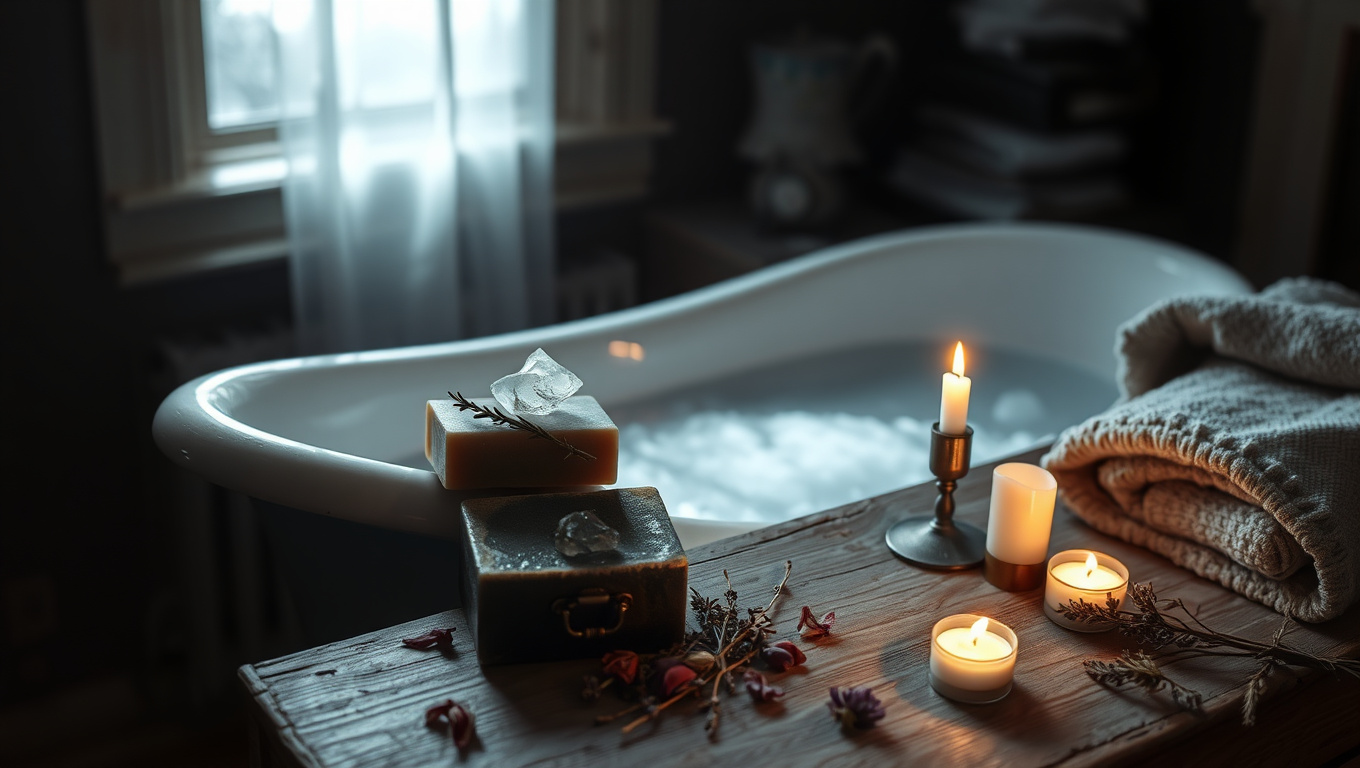
Dim the lights or turn them off entirely. Candles are traditional, and for good reason — candlelight is genuinely different from electric light. It flickers, it breathes. Two or three candles are plenty. If you work with specific colors in your practice, choose accordingly. Otherwise, white or beeswax candles are simple and beautiful.
If you have a window the moon might shine through, open a curtain. There is something quietly moving about actual moonlight on the water.
Step Two: Choose Your Ritual Soap Intentionally
Spend a moment, before your bath, actually looking at your soap. Smell it. Notice what it brings up for you — a memory, a feeling, a sense of what you need right now. This sounds small, but it’s one of the most effective ways to shift your mental state from “I’m taking a bath” to “I’m doing something on purpose.”
If you’re drawn to a full moon ritual centered on self-love or warmth, the Moonlit Cauldron soap — with its notes of blackberry, chocolate amber, and Roman chamomile — has a cozy, enveloping quality that suits a long, slow soak beautifully.
If you’re new to ritual soaps entirely and want to try a few before committing, Spellbound Grove offers a Build Your Sample Pack where you can choose two sample-sized bars, or even a free soap sample to try a single bar before investing in a full one. It’s a genuinely good way to find what resonates with your practice.
Step Three: Set an Intention Before You Get In
This is the piece most people skip, and it’s the piece that makes the biggest difference. An intention doesn’t have to be a formal statement. It can be as simple as a single word — release, clarity, rest — or a quiet sentence you say aloud or just think clearly before you step into the water.
Some people like to write their intention down first. Others prefer to hold it loosely in mind. Either works. What matters is that you arrive at the water with some sense of why you’re there — not just to get clean, but to mark something, release something, or call something in.
Step Four: The Bath Itself
Once you’re in, there’s really only one rule: stay longer than you think you need to. Most of us rush through everything. The whole point of a ritual bath is to stay in it. Let the water cool a little. Let your mind wander, then settle. Breathe the scent of your soap. Notice how the candlelight moves.
Some people use this time for prayer, meditation, or visualization. Some use it to think through something they’ve been avoiding. Some just rest, which is also valid — rest is not nothing. It is, for many of us, the hardest thing to give ourselves.
When you use your soap, do it slowly. This is the sensory center of the ritual. Notice the lather, the scent, the way the water changes around you.
Step Five: Close the Ritual
When you drain the tub, watch the water go. In many folk traditions, this draining is the physical act of release — whatever you came to let go of, it leaves with the water. You don’t have to believe this literally for it to be a useful image. There is something psychologically grounding about a clear ending to a ritual act.
Wrap yourself in a warm towel. Take a moment before you return to your phone or your list of things to do. Maybe drink a glass of water, or a cup of tea. Write something down if anything came up during the bath. Then go gently about the rest of your evening.
Seasonal Ritual Baths: Adapting Through the Year
One of the things I love most about a regular bath ritual practice is that it can move with the seasons. The same basic framework — intention, water, candlelight, a good bar of soap — shifts in feeling completely depending on the time of year and the soap you choose.
In autumn, especially around Samhain, a seasonal ritual soap like the Hollow Night ritual soap — with its notes of pumpkin cider, chocolate amber, and smoky sandalwood — fits the dark-month mood perfectly. It’s a cozy, grounding bar made for the turning of seasons, for baths that mark endings and honor what’s been.
In spring and summer, you might reach for something brighter: bergamot, honeysuckle, frankincense. In winter, deeper resins — myrrh, cedar, patchouli. The seasonal shift in scent is part of what makes this practice feel alive over time rather than like a static routine you repeat mechanically.
A Note on Making This Your Own
There is no authority on how to take a ritual bath. No certification, no tradition you must follow. The folk practices that inform modern witchy bath ritual come from many different cultures and time periods, and none of them belongs to any single person. Take what makes sense to you, leave what doesn’t, and don’t let anyone make you feel like you’re doing it wrong.
If you have five minutes and not an hour, five minutes is enough. Light a candle, breathe the scent of your soap, hold a thought for thirty seconds about what you’re setting down or calling in. That’s a ritual. Small doesn’t mean meaningless.
If you want to go deeper — longer baths, journaling before and after, working with specific moon phases, building a small altar near the tub — there is plenty of room to grow into that. But start where you are. The water is ready when you are.
Finding the Right Handmade Witch Soap for Your Practice
The ritual bath is an old, quiet tradition dressed in new language for a new era. What has always been at the center of it is simple: a moment of deliberate care. Water, warmth, a scent that opens something in you, and the choice to be present for a little while.
A good handmade witch soap can hold a lot of that. Not because it’s magic in the theatrical sense — because it was made with real ingredients by real hands, and when you hold it, you can feel that. It grounds the ritual in something physical. Something that actually smells like something, lathers like something, leaves your skin feeling like something. The sensory experience is the point.
If you’re ready to build your own moonlit bath practice, or simply want to make your next bath feel like more than a chore, explore the handcrafted ritual soaps and botanical bath goods at Spellbound Grove. Every bar is made in small batches, with real botanicals and genuine intention. There’s something there for every season, every mood, and every kind of witch — including the kind who just needs a long, quiet soak and a soap that smells like the night.