
When the Day Gets Heavy, the Ritual Gets Simple
There are evenings when you come home and the weight of everything is just sitting there, right behind your sternum, waiting. You are not sad, exactly. Not anxious, exactly. You are just full of something that hasn’t moved in a while. The kind of feeling that a scroll through your phone won’t touch, that a glass of wine only softens temporarily. What you actually need is a moment of honest stillness.
This is where ritual lives — not in elaborate ceremonies, but in the small, grounded acts of paying attention. A candle lit with some intention behind it. The smell of cedarwood or vetiver filling a room. Water running warm. A bar of handmade witch soap held in your hands like a small, fragrant anchor. These things work not because they are magic in a theatrical sense, but because they ask you to slow down and be present. And sometimes that is the whole point.
The ritual in this article is built around shadow work — a practice of sitting with the parts of yourself you usually push past — and around the specific scent world of Shadow and Sage Natural Witch Ritual Bar Soap from Spellbound Grove. You do not need to be a practicing witch to find something useful here. You only need to be willing to be quiet for a little while.
What Shadow Work Actually Is (And Isn’t)
The phrase “shadow work” gets thrown around a lot, so it is worth pausing on what it actually means in everyday terms. The concept comes from the writing of Swiss psychiatrist Carl Jung, who used the word “shadow” to describe the parts of the self that we tend to suppress, deny, or simply not look at directly — old patterns, feelings we find inconvenient, reactions we are not proud of. Shadow work is the practice of turning toward those parts rather than away from them.
It is not about being harsh with yourself. In folk and witchcraft traditions, shadow work is often framed as a form of honest self-witnessing — a ritual of seeing clearly, without the usual armor. It can be as simple as journaling about a recurring reaction you don’t understand, or sitting quietly with an emotion that usually sends you reaching for a distraction. The point is presence, not perfection.
Why Scent and Ritual Matter Here
Scent has long been used in contemplative and ritual practices across cultures — incense in temples, herbs burned before ceremony, fragrant oils worked into the skin before prayer or meditation. There is something about a strong, grounding scent that signals the body to shift gears. Cedarwood, vetiver, firewood — these are not light, airy notes. They are earthy and persistent. They ask you to drop down into yourself rather than float away.
Shadow work benefits from this kind of anchoring. When you are doing honest, quiet inner work, you want something that keeps you present rather than sending your mind somewhere gauzy and pleasant. The ritual soap you reach for matters. Its weight, its smell, the feeling of working lather into your skin — these are sensory cues that can mark the beginning and end of intentional time.
Getting to Know Shadow and Sage
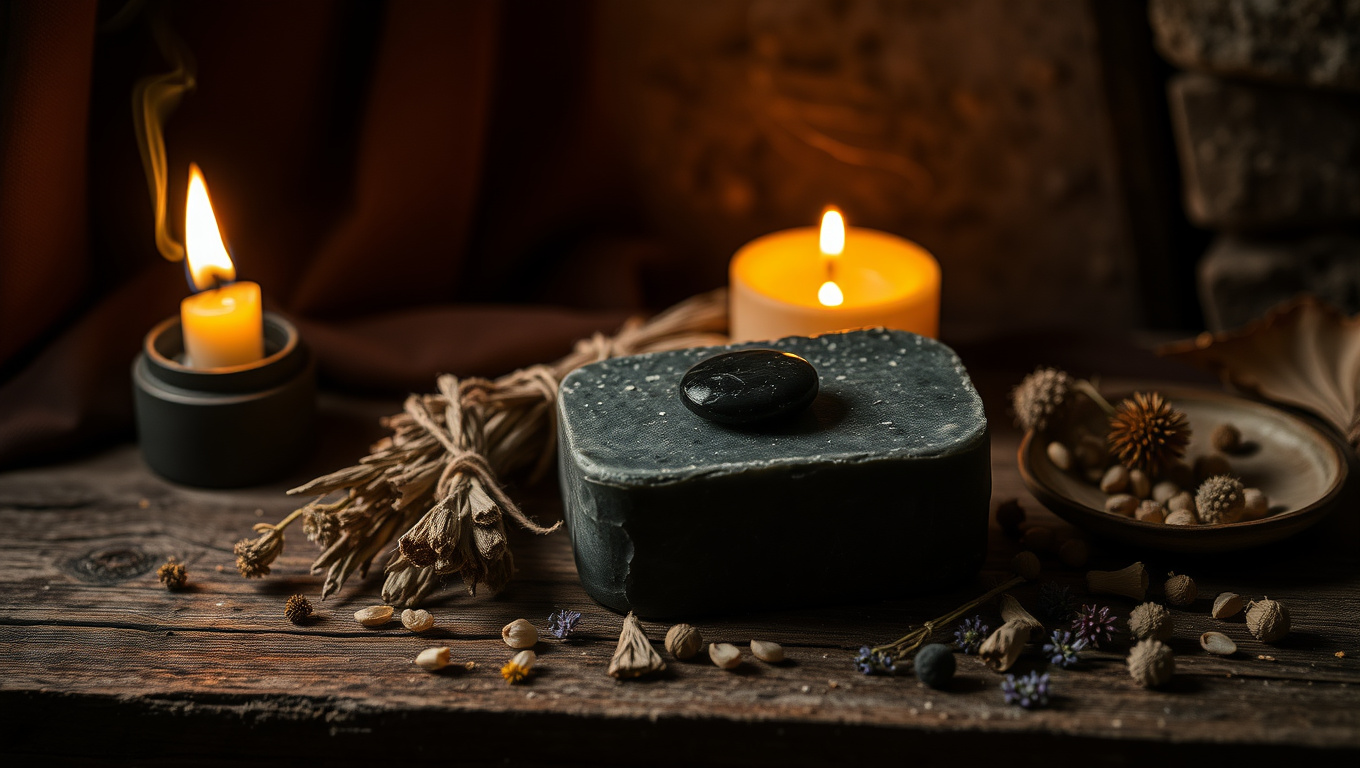
Spellbound Grove’s Shadow and Sage is a small-batch ritual soap crafted for exactly this kind of work. The scent profile is grounding and layered: vanilla and cedarwood at its core, with vetiver and the dry, smoky warmth of firewood running underneath. There is a black obsidian adornment worked into each bar — a nod to the stone’s long folkloric association with clarity and truth-seeing.
The description from Spellbound Grove says it plainly: this bar is made for rituals of release, cleansing, and courage. It suits moments before divination or journaling. Or, as they put it, simply washing the day away. That honesty is part of what makes it work. There is room here both for the deeply intentional practitioner and for the person who simply needs to shed what the day left on them before they can rest.
The Botanicals and What Folk Tradition Says About Them
Vetiver is a grass native to South Asia, and its root has been used in traditional perfumery and folk practice for centuries. Its scent is deep, smoky, and a little sweet — often described as raw earth after rain, or the inside of an old library. In various folk traditions, vetiver has been associated with grounding energy and stability. It is not a delicate note. It holds.
Cedarwood has a similarly long folk history. The cedar tree appears in the mythology and spiritual practice of dozens of cultures — from Indigenous North American traditions to ancient Near Eastern ritual. It was burned in ceremony, used to protect sacred spaces, and associated with strength and longevity. As a scent, it is warm and slightly resinous, with a woody dryness that feels settled rather than sharp.
Vanilla softens both of these, adding a quiet sweetness that keeps the overall scent from feeling austere. And firewood — that dry, ashy, campfire warmth — pulls the whole thing together into something that smells like late autumn, like the edge of a forest at dusk, like something honest and a little old.
Building the Ritual: A Step-by-Step Shadow Work Bath Practice
This is a practical ritual. You do not need much. What you need is time — ideally thirty to sixty minutes when you will not be interrupted — and a genuine willingness to sit with yourself. The steps below are suggestions, not rules. Adapt them to your space, your energy, and what you actually have available.
What to Gather
- Your bar of Shadow and Sage ritual soap
- One or two candles — dark colors like black, charcoal, or deep green suit this work, but use what you have
- A journal and pen, left within reach but not in the bath
- A small bowl or dish if you want to leave an herb or stone nearby — black obsidian, smoky quartz, or dried mugwort are traditionally associated with introspection in folk practice
- Optional: a cup of something warm to have after — black tea, a reishi mushroom drink, or plain hot water with lemon
Setting the Space
Start before you even turn on the tap. Put your phone in another room, or at least in a drawer. Turn off overhead lights. Light your candles. If you have a window, crack it a little — moving air matters in cleansing rituals across many folk traditions, and there is something genuinely useful about the feeling of a room that breathes.
Take one minute — just sixty seconds — standing in the bathroom before you do anything else. Notice what you are carrying. Where does the tension live? What thoughts are circling? You are not trying to fix any of it. You are just noting it, the way you might note the weather before going outside. This small act of honest witnessing is the first step in shadow work.
The Bath Itself
Run the water warm — not scalding, just comfortably warm. As the tub fills, hold the bar of Shadow and Sage in your hands for a moment. Notice its weight. Take a slow breath of its scent. Cedarwood, vetiver, firewood, vanilla. Let that smell be a marker. This is the beginning of your intentional time.
Once you are in the water, resist the urge to do anything for the first few minutes. No thinking about tomorrow, no planning, no mentally composing messages. Just the warmth of the water and the scent of the soap. If your mind wanders — and it will — simply notice that it wandered and come back to the physical sensations. The weight of water. The smell of cedarwood. The flicker of the candle.
When you are ready, work the soap into a lather and wash slowly. This is not something to rush. There is a long folk tradition of associating washing with release — of water carrying away what is no longer needed. You do not have to hold that belief literally for the act of slow, attentive washing to feel meaningful. The attention itself is the ritual.
The Journaling After
This is where shadow work gets specific. Once you are out of the bath and wrapped in something warm — robe, blanket, soft clothing — sit with your journal before you do anything else. Set a timer for ten minutes if that helps you commit.
Write without editing. Below are a few prompts to get you started, but you can ignore them entirely and simply write whatever is in front of you:
- What emotion have I been avoiding or numbing this week?
- What reaction did I have recently that surprised or embarrassed me? What might be underneath it?
- What am I holding onto that I know, honestly, is ready to be released?
- What does the version of me who is brave and well-rested already know about this situation?
You do not have to answer these neatly. Messy, incomplete writing is often the most honest. The point is to look at something directly, even briefly, rather than moving around it.
Ritual Soap for the Full Moon: A Variation
Shadow work is often associated with the waning moon — the two weeks between full moon and new moon, when the energy of folk lunar practice traditionally turns inward toward release and reflection. But many people find the full moon a powerful time for this work too, when things feel lit up and unavoidable, when whatever has been lurking in the background suddenly seems impossible to ignore.
If you want to align this ritual with the full moon, a few small adjustments suit the energy. Use a white candle alongside a dark one. After your bath journaling, write something you want to release on a small piece of paper and fold it away — some people burn it safely, others bury it, others simply put it somewhere they won’t look at for a month. The act of physically setting something aside is not magic in a supernatural sense, but it is a genuine and useful psychological gesture of intention.
For a full moon ritual bath with a slightly different scent world, Triple Moon Goddess Natural Witch Ritual Bar Soap from Spellbound Grove offers a softer, more luminous character — lavender, frankincense, myrrh, and vanilla with an amethyst adornment. It is described as ideal for moon baths and spiritual cleansings, and its scent — light, floral, a little powdery — feels like moonlight where Shadow and Sage feels like forest floor. Both are honest, small-batch, and genuinely handcrafted. Which one you reach for depends on what your ritual calls for.
Caring for Your Handmade Soap Bar
A small note on the practical side, because handmade witch soap is different from commercial soap and deserves a little different care. Small-batch, handcrafted bars are made with natural oils and butters — they contain glycerin, which is a natural byproduct of the soapmaking process and is often removed from commercial bars. This makes them richer and more moisture-friendly for the skin, but it also means they can get soft if they sit in standing water.
Keep your bar on a well-draining soap dish between uses. Let it dry completely. If your bathroom runs humid, a dish with drainage slots or a wooden soap rest works well. A bar cared for this way will last significantly longer. And since these are small-batch, handcrafted bars with no synthetic preservatives or fillers, treating them well is part of respecting the craft that went into making them.
If you are new to Spellbound Grove’s soaps and want to find your footing before committing to a full bar, the Free Soap Sample is a genuinely useful option — one handcrafted sample, your choice of scent, available in regular or nut-free. It is a low-stakes way to learn what a scent actually does on your skin rather than just reading about it.
The Quiet Power of Doing This Regularly
One ritual bath will not transform your life. But a practice — something you return to once a week, or once a month on the new or full moon — can genuinely shift how you relate to yourself over time. Not because of any supernatural mechanism, but because you are repeatedly choosing to pay attention to your inner life rather than running past it.
Folk practitioners of all kinds have known this for a long time. The herbs burned, the water drawn, the candle lit — these are not the magic. The magic is the intention behind them, and the consistency of returning. A grounding ritual with handmade witch soap is, at its core, just a way of saying: this time is mine, and I am going to use it honestly.
That is worth something. Most things that are quietly worth something don’t announce themselves loudly. They just ask you to show up.
Finding Your Ritual Soap at Spellbound Grove
If this kind of intentional, sensory, grounded ritual appeals to you, Spellbound Grove makes it easy to explore. Every bar is handcrafted in small batches with real botanical ingredients, real attention, and a genuine understanding of the folk traditions that shape this kind of work. Shadow and Sage is a natural starting point for anyone drawn to release, reflection, and the honest, earthy scent of cedarwood and vetiver — but there are many bars in the collection, each with its own character and seasonal logic.
If you are curious, I would suggest starting with the free sample and going from there. Or browse the full handcrafted collection at Spellbound Grove and see what pulls at you. Sometimes a scent description is enough. Sometimes you need to smell it. Either way, the ritual is waiting for you whenever you are ready to begin.