The Symbolism of Ravens, Skulls, Cats, and Brooms in Witchy Aesthetics — and the Handmade Witch Soap That Honors Them
Pick up a piece of handmade witch soap and chances are it’s already speaking a visual language — a carved raven pressed into the top, a shimmer that calls to mind a moonlit night, a stone nestled in the lather like something unearthed. These aren’t random design choices. The symbols that define witchy aesthetics have roots that run deep: into old folklore, folk magic traditions, seasonal ceremony, and centuries of human storytelling. Ravens, skulls, cats, and brooms are four of the most immediately recognizable icons in that visual vocabulary. But where did they actually come from, and why do they still feel so charged with meaning?
That’s worth sitting with for a moment. Because when you really look at the history behind these symbols, they stop feeling like mere aesthetic choices and start feeling like something older — a thread you’re picking up that someone else was holding a very long time ago. There’s a reason these images keep returning, in art and craft and ritual, season after season. They carry something. And if you’ve ever felt a quiet pull toward them, there’s probably a reason for that too.
This is a look at four of the most enduring symbols in witchy culture — not as spooky decoration, but as genuine pieces of folk history and meaning. Along the way, there’s a little guidance on how these symbols weave into ritual living today, from the objects you keep on your altar to the soap sitting on your bathroom shelf.
The Raven: Messenger, Oracle, Keeper of Secrets
Few creatures carry more symbolic weight than the raven. Across an enormous range of cultures — Norse, Celtic, Indigenous North American, Greek, and more — the raven has been regarded as something between a messenger and a trickster, a guide between worlds, a bird that sees and knows more than it lets on.
In Norse tradition, Odin kept two ravens named Huginn and Muninn, often translated as “Thought” and “Memory.” They were said to fly across all the worlds and return to whisper what they had seen into the god’s ear. That’s a powerful image: the raven as an extension of mind and memory, a creature that gathers knowledge from places ordinary eyes can’t reach.
In Celtic tradition, ravens were associated with battle and prophecy, and with the goddess Morrigan — a shapeshifter connected to fate and sovereignty. The raven’s ability to survive, to thrive in liminal spaces between life and death, between the wild and the human world, made it a natural symbol for those who worked in the spaces between things.
In folk belief more broadly, ravens were often seen as omens — though not always bad ones. Their intelligence, their ability to mimic sound, and their tendency to appear at significant moments gave them a reputation as witnesses to the unseen. They notice things. They remember.
Ravens in Witchy Aesthetics Today
Today the raven appears on everything from altar cloths to apparel to handcrafted goods. It represents wisdom, sharp perception, and a willingness to look at what others look away from. If you’re drawn to the raven, you’re drawn to depth — to the idea that knowledge is worth seeking even when it’s uncomfortable. The Bone Collector Crew Tee from Spellbound Grove features a raven perched on a skull — two of the most layered symbols in witchy iconography, combined into a single image that feels simultaneously ancient and immediate. It’s the kind of design that resonates not because it’s edgy but because it’s honest about the fact that beauty and darkness often share space.
The Skull: Not Death, But the Remembrance of Life
The skull makes people uncomfortable in a way that’s actually worth examining. In contemporary Western culture, we’ve largely separated the skull from its older meanings and left it as shorthand for danger or mortality, a warning sign on a bottle of poison. But in folk traditions worldwide, the skull carried far more nuanced meaning.
In Mexico, the tradition of Día de los Muertos uses decorated skulls — calaveras — not as symbols of fear but as celebrations of the people who have died. The skull in that context is an act of love, of remembrance, of insisting that the dead are not forgotten. It’s about continuity, not ending.
In many Western esoteric and folk magic traditions, the skull has long symbolized transformation, the shedding of what is no longer needed, the courage to face impermanence honestly. Memento mori — “remember that you will die” — was a philosophical tradition in ancient Rome and carried into medieval and Renaissance art, not as morbidity but as a call to live with intention. If you know your time is finite, how do you want to use it?
The skull, in the witchy aesthetic, asks the same question. It sits at the intersection of death and reverence, of endings and what they make possible. Shadow work — the practice of exploring the parts of yourself you usually avoid — often uses imagery like the skull as a reminder that honest self-examination, though uncomfortable, is ultimately transformative.
Working with Skull Symbolism in Ritual
You don’t have to have a skull collection or an elaborate altar to work with this symbolism. Simply acknowledging the turning of seasons — the way autumn shifts toward winter, the way a full moon gives way to darkness — is its own form of practicing that same philosophy. A bar of ritual soap used at the threshold of seasons, as a way of marking what you’re leaving behind and what you’re moving into, is a small but genuine practice. The Hollow Night ritual bar from Spellbound Grove was made for exactly this kind of moment — its scent of pumpkin cider, chocolate amber, and smoky sandalwood is deeply autumnal, suited to the turning of the year and the kind of honest reckoning that comes with it. Adorned with black obsidian, it’s a bar that doesn’t shy away from the darker, richer notes of the season.
The Black Cat: Familiar, Guardian, and the Witch’s Companion
The black cat has one of the most complicated histories in the archive of witchy symbolism. In medieval Europe, black cats became associated with witchcraft during a period of widespread fear and persecution, and that association was rarely flattering — cats, particularly black ones, were believed to be witches’ familiars, supernatural helpers through which a witch might work magic. The Church cast this in a sinister light, and for a long time, black cats suffered for it in very literal ways.
But that tells only part of the story. In ancient Egypt, cats were revered — the goddess Bastet took a feline form and was associated with protection, home, and the warmth of the domestic. In Japanese folklore, the maneki-neko, the beckoning cat, is an emblem of good fortune. In Norse mythology, the goddess Freya rode in a chariot pulled by two large cats. The cat’s association with the otherworldly, the intuitive, and the independent runs across many traditions — and most of them look on it with admiration rather than suspicion.
The familiar as concept is also more layered than its reputation suggests. In folk magic tradition, a familiar was often understood as a spirit companion — an entity that worked alongside a practitioner, offering guidance and protection. The idea that an animal could be attuned to a person in a way that went beyond ordinary companionship speaks to something many people feel instinctively, whether or not they’d frame it in magical terms.
Hecate’s Cat and the Witchy Tradition
The goddess Hecate has a particularly strong association with cats in folk and magical tradition. As a deity of crossroads, thresholds, and the passage between worlds, Hecate was often depicted accompanied by creatures that live in liminal spaces — dogs, serpents, and cats among them. There’s a reason the Hecate’s Feline Friend handmade witch soap is named exactly as it is. Scented with cypress, lavender, clary sage, cedarwood, and patchouli, and embedded with prehnite, it’s a bar that carries the earthy, resinous, quietly wild quality that feels right for working with Hecate’s energy — that sense of old power, of walking soft but knowing a great deal. It’s suited for moonlit baths, quiet evenings, or any moment when you want to feel more connected to your own instincts.
The Broom: More Than Just a Flying Cliché
Of all the witchy symbols, the broom may be the most thoroughly misunderstood — reduced to a prop in Halloween decorations when its actual folk history is genuinely interesting. The broom, or besom, has a long presence in folk magic across Europe. It was used for ritual cleansing of a space before ceremony — not physical sweeping so much as energetic clearing, moving out stagnant energy from a room before working magic or welcoming guests. Jumping the broom at weddings, a tradition recorded in various parts of Europe, was a way of marking a threshold and sweeping the old life away to make room for the new.
The flying witch on a broomstick is a much later, largely literary and artistic construction that became codified in early modern Europe. Its origins are debated by historians, and it’s worth being honest that the idea of witches literally flying was used as propaganda during a very dark chapter of European history. Over time, that image was largely stripped of its menace and became costume shorthand — the pointy hat, the broom, the black cat. Familiar, almost cozy.
But underneath the costume lies a real object with real tradition. The besom was — and is — a practical tool for ritual. Many practitioners today still keep one at the entrance of their home and use it in seasonal cleansing ceremonies.
The Broom as Symbol of Threshold and Transition
The broom marks edges. The threshold of a door. The boundary between the old and the new. In that sense it connects to the same ideas carried by the skull and the raven — transformation, transition, the willingness to stand at the edge of something and step forward. It’s a humble object with an honest purpose: to clear what’s no longer needed. There’s something quietly beautiful about that. The Broom Parking Only Hoodie from Spellbound Grove takes that symbol and plays with it warmly — because sometimes the best way to honor an old tradition is to wear it with a sense of humor and affection.
How These Symbols Come Together in Witchy Living Today
What strikes me most about these four symbols — the raven, the skull, the cat, the broom — is that none of them are really about fear. They’re about edges. About the places where one thing becomes another: life and death, wild and domestic, the known and the unknown. They show up in witchy aesthetics because people drawn to that aesthetic tend to be comfortable with complexity. They don’t need everything to be sanitized or neat. They find meaning in the turning of seasons, in the dark half of the year, in the creatures that navigate shadows with confidence.
That’s also what good ritual soap does, in its small and sensory way. It marks a threshold. The act of washing — slowly, intentionally, with something that smells of old resins and garden herbs and woodsmoke — is a way of saying: I’m moving from one state to another. From the day into the evening. From the noise into the quiet. From what I was carrying to what I’m putting down.
Building a Simple Ritual Around These Symbols
You don’t need an elaborate setup for this. What follows is a simple practice you can adapt to your own pace and preference.
- Set the space. Before you bathe or wash, take a moment to clear the room — open a window briefly, light a candle, or simply take three slow breaths. Think of it the way you’d think of a besom sweeping a threshold: you’re signaling to yourself that this time is different from ordinary time.
- Choose your bar intentionally. Pick a soap whose scent matches what you’re working with. Smoky, resinous, dark-note soaps suit seasons of reflection and release. Floral, citrus, and lighter botanical notes suit mornings, new beginnings, or rituals of openness.
- Name what you’re releasing. As you lather and rinse, think briefly about what you’re washing away. Not in an overwrought way — just a quiet acknowledgment. A thought, a habit, a mood. The water takes it.
- Name what you’re welcoming. As you step out and dry off, think about what you want to carry forward. One word is enough. Clarity. Patience. Courage. Warmth.
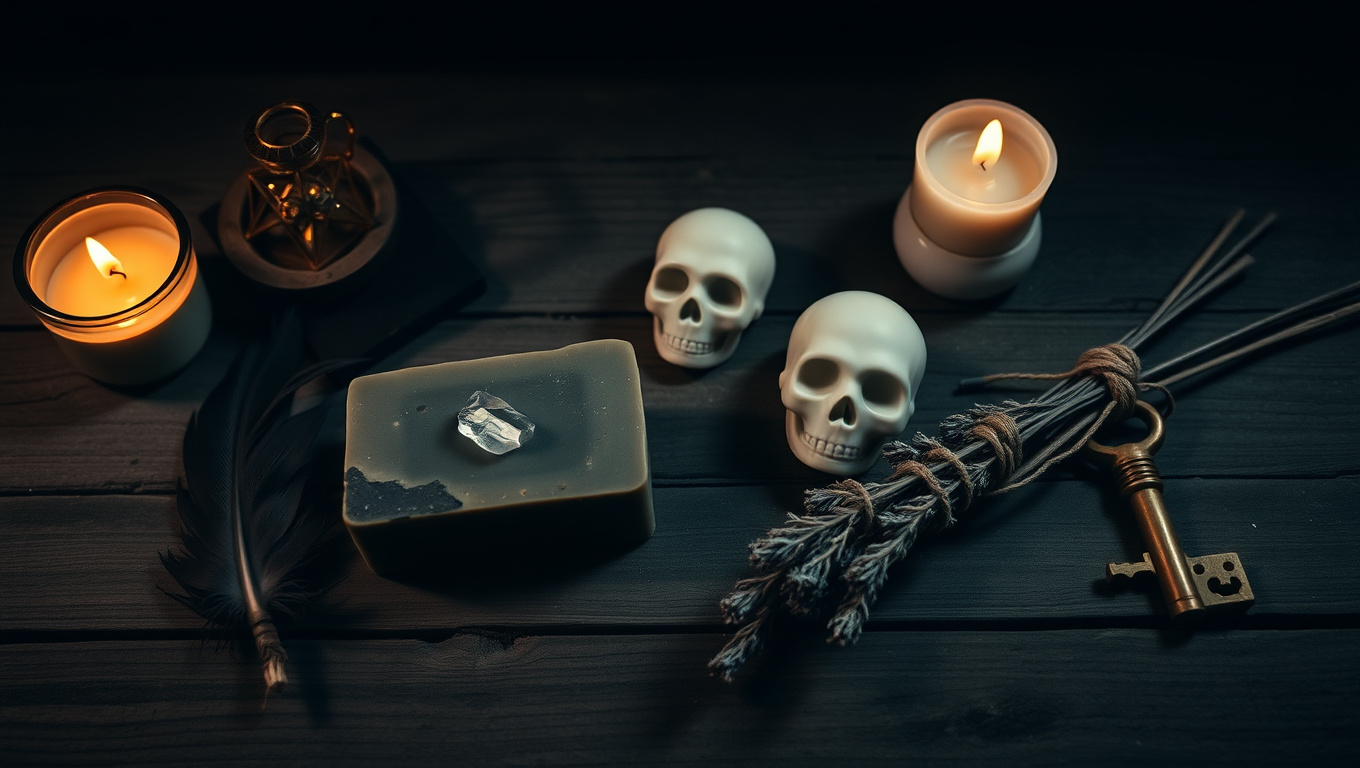
- Let the objects around you remind you. A raven figure on the shelf. A skull candle holder. A sprig of dried herb. These aren’t decorations so much as markers — things that hold meaning you’ve decided to put in them.
Ritual doesn’t have to be complicated to be real. The symbols help because they’re visual anchors — they keep you oriented to what you’re doing and why. That’s what folk magic has always done, at its most practical: given people a way to pay attention.
Finding Handmade Witch Soap That Means Something
There’s a real difference between a soap that’s been made in a large facility and poured into a witchy mold, and one that’s been crafted in small batches with actual intention — where the scent combinations were chosen carefully, where the adornments embedded in the bar mean something, where the person making it is genuinely thinking about the person who will use it. Small-batch handmade witch soap sits in that second category. You can often tell by the way it smells, the way the lather feels, the weight of it in your hand. It’s a different thing entirely.
If you’re new to ritual soap and not sure where to start, trying a sample before committing to a full bar is a sensible way to go. Spellbound Grove offers a free soap sample — one per customer — so you can experience the lather and scent before choosing. It’s a genuinely useful offer for anyone who’s particular about what they bring into their bathing ritual, which, if you’ve read this far, you probably are.
For those who already know their preferences, the Build Your Sample Pack lets you choose two sample-sized bars from the full range — a good way to compare scent families or find what suits different moods and seasons.
Conclusion: Symbols Are How We Pay Attention
The raven watches. The skull remembers. The cat moves quietly between worlds. The broom sweeps the threshold clean. These four symbols have lasted because they speak to something real about how humans experience time, change, loss, and magic. They’re not spooky for its own sake — they’re honest about the fact that life includes darkness, and that the darkness is worth understanding rather than avoiding.
When that symbolism shows up in the things you wear, the objects you keep, and the handmade witch soap you reach for at the end of a long day, it becomes part of a larger practice of intentional living. Small acts, done with awareness, accumulate into something meaningful. That’s all ritual really is.
If you’re looking for soap and goods that take that philosophy seriously — made with real botanicals, in small batches, with genuine care for the craft — I’d gently recommend taking a look at the handcrafted soaps and witchy goods at Spellbound Grove. There’s a bar for nearly every kind of ritual, every season, every mood. And if you’re not sure where to start, the free sample is there for exactly that reason.