The Soap That Took Me Somewhere Else
It happened in the middle of an ordinary Tuesday. I was unwrapping a new bar of soap — cedarwood, patchouli, a hint of clary sage — and before I’d even turned on the tap, I was standing in a memory. Pine needles underfoot. October air. A specific afternoon that had nothing to do with soap at all. That’s the thing about scent. It doesn’t ask permission. It just arrives.
This is part of what makes handmade witch soap feel so different from anything you’d grab off a drugstore shelf. Mass-produced soap is designed to smell clean, inoffensive, forgettable. Small-batch ritual soap — the kind made slowly, with real botanicals and intention — tends to carry something richer. Something that lingers on the skin and in the mind. And when you pair a particular scent with a particular ritual, something interesting starts to happen. The soap becomes more than soap. It becomes a key.
Understanding a little about how scent memory actually works can change the way you approach something as simple as your morning wash. Not because you need to turn everything into a ceremony, but because knowing the why behind an experience makes it feel more real — and more yours.
Why Scent Memory Is Different From Every Other Kind
Most sensory information — what you see, hear, touch — gets processed through the thalamus before it reaches the emotional and memory centers of the brain. Smell doesn’t work that way. Olfactory signals travel almost directly to the limbic system, which includes the amygdala and hippocampus — structures involved in emotion and memory. It’s a shorter path, and a more immediate one. That’s why a smell can drop you into a feeling before you’ve even consciously identified what you’re smelling.
This phenomenon — the rush of memory triggered by a scent — is sometimes called the Proustian memory effect, named after the French novelist Marcel Proust, who described it vividly in his writing. Researchers have explored this connection for decades. The general finding, broadly speaking, is that smell-evoked memories tend to feel older and more emotionally charged than memories triggered by other senses. They often reach further back. They feel more surprising, more involuntary.
Which is just another way of saying: scent remembers things for you.
What This Has to Do With Ritual
Ritual, at its core, is about repetition with meaning. You do something regularly, intentionally, in roughly the same way — and over time, the act accumulates weight. It starts to signal something to your nervous system. It marks time. It creates a container.
Scent fits into this beautifully. When you use the same ritual soap at the same moment — every new moon, every Sunday morning, every evening before journaling — the scent becomes woven into the texture of that practice. Eventually, just catching a whiff of it begins to shift your mental state. Not through magic exactly, though it can feel that way. Through the very ordinary, very powerful mechanism of scent memory doing what it does.
This is one reason so many people who practice witchy self-care are drawn to handmade, small-batch soap over anything synthetic. The scent profiles tend to be more complex, built from actual botanical oils and resins rather than lab-created fragrance approximations. Complex scents create richer, more layered memories. And natural ingredients tend to shift slightly as the bar cures and ages — which means your relationship with the soap changes over time, too.
How Handmade Soap Carries Scent Differently
There’s a practical reason handmade soap smells the way it does. Traditional cold-process and hot-process soapmaking retains the glycerin that forms naturally during saponification — the chemical reaction that turns oils and lye into soap. Commercial manufacturers often remove that glycerin to sell separately. What’s left is a harder, drier bar that can strip the skin and carry fragrance less richly.
Small-batch natural soap keeps the glycerin in. This makes the lather softer and the bar feel more nourishing against the skin. It also means the scent behaves differently — it tends to bloom when it hits warm water and steam, releasing in waves rather than all at once. That slow unfolding is part of what makes a ritual soap feel like an experience rather than just a product.
Natural ingredients carry their own scent stories, too. Patchouli is earthy and deep, with centuries of use in folk traditions across South and Southeast Asia. Frankincense resin has been burned in sacred spaces for thousands of years across multiple cultures — its warm, slightly sweet smoke is one of the oldest ritual scents in the world. Myrrh has a similar ancient lineage. Lavender, cedarwood, clary sage — these aren’t just pleasant smells. They’re plants with long histories of human use, which means they often carry cultural and emotional resonance even before they become personal.
When Botanicals Carry Folklore
Part of what makes a handmade witch soap feel distinct is the intention behind which botanicals are chosen and why. Folk herbal traditions — from European cunning craft to Appalachian root work to the plant knowledge of countless other cultures — have long associated certain plants with certain qualities. Cypress with transitions and the underworld. Rose with love and the heart. Clary sage with vision and clarity. These associations aren’t medical claims. They’re cultural shorthand, accumulated over centuries of human observation and story.
When a soapmaker chooses cypress and patchouli for a soap dedicated to Hecate, goddess of the crossroads and the liminal dark, they’re drawing on that shorthand. The scent isn’t doing something chemical to your psyche. But it’s carrying meaning. And meaning matters enormously to how an experience lands.
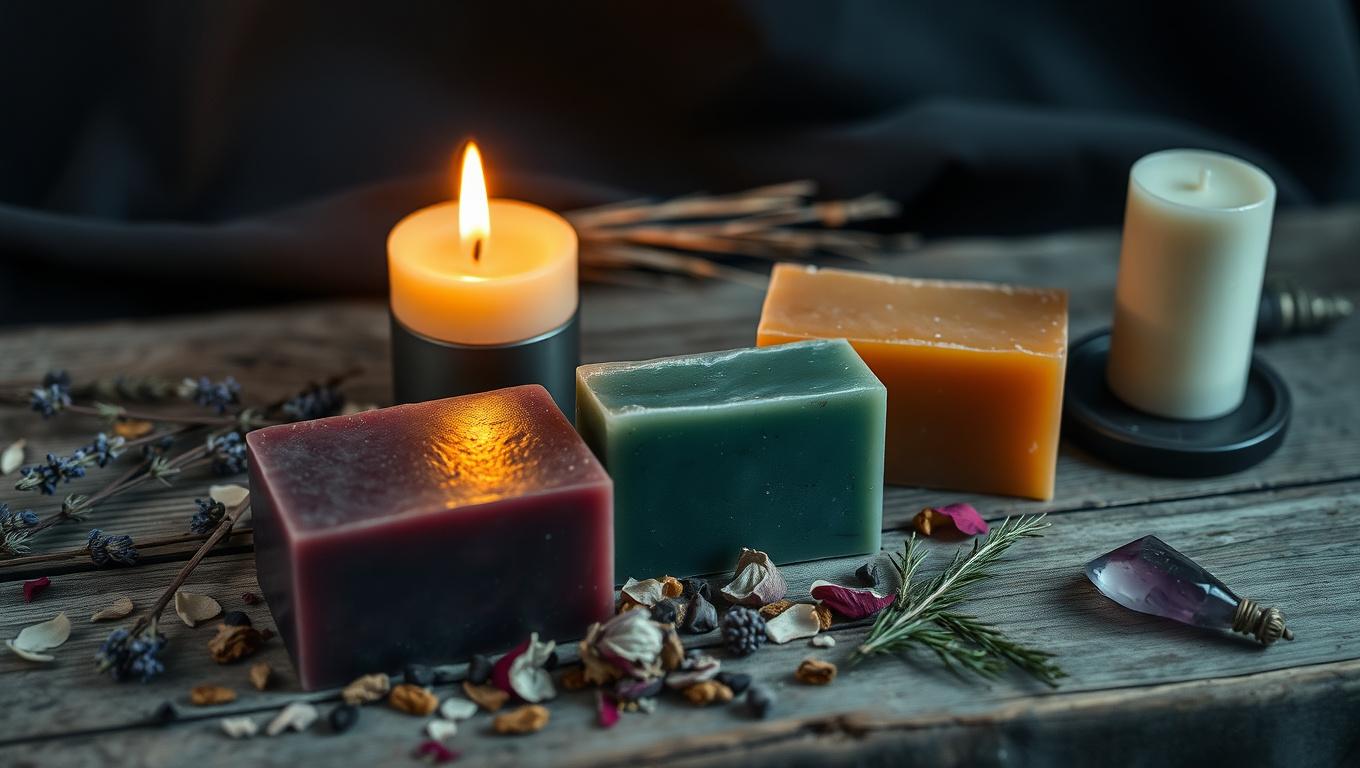
Take Hecate’s Feline Friend from Spellbound Grove as an example. The bar is built around cypress, lavender, clary sage, cedarwood, and patchouli — a grounding, smoky, softly herbal combination that feels unmistakably nocturnal. Using it for a moonlit bath or a quiet evening ritual means that scent becomes associated with stillness, with intentionality, with whatever you were thinking about when you stood in that steam and let the day fall away. The next time you smell those notes together — anywhere — there’s a good chance that ritual comes back to you.
Building Your Own Scent Associations Intentionally
You don’t have to be a practicing witch to benefit from building scent anchors into your routine. You just have to be someone who bathes, who values some amount of quiet, and who’d like certain moments to feel more marked than others.
Here’s a simple way to start.
Choose One Soap for One Intention
Pick a ritual soap with a scent profile that genuinely resonates with you — not just one that smells nice in the abstract, but one that feels like something. Maybe it’s dark and resinous, good for evenings when you want to think deeply. Maybe it’s bright and floral, the kind of scent that suits slow Sunday mornings. Maybe it’s warm and spiced, something you want to reach for when autumn comes and the light changes.
Use that soap consistently for the practice you’re associating it with. Don’t use it at random. Let it belong to something.
Create a Small, Repeatable Ritual Around It
It doesn’t need to be elaborate. A few candles. A specific playlist or silence. The same time of day or the same phase of the moon. Warm water, unhurried. Hold the bar before you begin, notice the scent before the steam changes it. Take a breath. Let that be the signal: this is the moment. This time belongs to me.
Over weeks and months, that sequence becomes a groove. The scent becomes the doorway.
If you’re drawn to the energy of the full moon, a soap like the Triple Moon Goddess — layered with lavender, frankincense, myrrh, and vanilla — lends itself naturally to this kind of moon ritual soap practice. Its scent is described as softly floral and powdery, something that lingers on the skin long after the bath is done. Over time, catching that particular blend in the air could be enough to bring the whole mood of a full moon night back to you in an instant.
Let the Soap Change With Your Needs
Scent associations don’t have to be fixed forever. Sometimes a soap you used through one season of your life will smell different once that season has passed — not because the soap changed, but because you did. That’s okay. Let the soap retire gracefully. Start something new.
If you’re moving through a period of shadow work or intentional release, something like the Shadow and Sage bar — with its notes of vanilla, cedarwood, vetiver, and firewood — has the kind of grounding, earthy warmth that suits those heavier, more introspective practices. It was made specifically for rituals of release and courage, and its scent carries that quality. Vanilla softens what cedarwood and vetiver ground. Firewood suggests something being transformed.
Why Small-Batch Matters for Scent Memory
Mass production flattens things. It optimizes for consistency at scale, which means every bar off the line smells exactly the same as the last. That’s not inherently bad — predictability has its place. But scent memory thrives on texture, on the slight variations that come from handwork, from seasonal ingredient batches, from a maker who is paying genuine attention.
Small-batch ritual soap is made in quantities where the maker can actually smell every batch, adjust, and respond. The person who formulated the scent is often the same person who poured it, cut it, and cured it. There’s a handprint on the thing, even if you can’t see it. And somehow — maybe because humans are wired to respond to evidence of other humans’ care — that comes through in the experience of using it.
When you hold a bar of handcrafted soap that was made with a specific intention in mind, there’s something in that knowledge that changes the way you interact with it. You bring more attention. You slow down a little. And attention, it turns out, is exactly what makes a scent memory stick.
Choosing a Handmade Witch Soap That Fits Your Practice
If you’re new to ritual soap and not sure where to start, a few thoughts.
First: trust your nose more than the label. Read the scent notes carefully and notice which combinations pull at something in you. Resinous and dark? Floral and dreamy? Green and herbal? Your instincts about scent are often good ones.
Second: think about when you’ll use it and what you want that time to feel like. A soap for a morning ritual might want to be brighter, lighter. A soap for evening or shadow work might want to be deeper, more complex.
Third: don’t overthink it. A handmade witch soap is still soap. It is allowed to just smell wonderful. The ritual meaning you bring to it is yours to build, or not. Either way, you’re getting something made with care from real ingredients by real hands — and that’s already worth something.
If you’re genuinely unsure, Spellbound Grove offers a free soap sample — one per customer, in your choice of scent — which is exactly the right way to start. You can’t fully know how a scent will settle on your skin and in your memory until you live with it for a little while.
The Quiet Magic of Something That Remembers
A bar of handmade witch soap won’t change your life on its own. But it can be a small, grounded, genuinely beautiful thing that you return to again and again — and over time, it starts to hold some of your life inside it. The mornings you woke up tired and managed anyway. The rituals that felt silly at first and profound after three months. The particular quality of autumn light through a steamy bathroom window.
Scent is one of the few things that can hand all of that back to you, instantly, years later. That’s not mysticism. That’s just how human memory works. But it’s close enough to magic that I’ve stopped trying to tell the difference.
If you’d like to find a bar that suits your practice, your season, or simply your nose, explore the handcrafted soaps at Spellbound Grove. Every bar is made in small batches, with real botanicals, by people who take this work seriously — and who believe that the things you use every day deserve to be beautiful.