The Full Moon, a Hot Bath, and a Bar of Handmade Witch Soap
There’s something about a full moon that makes you want to wash something off. The day’s tension. A season’s worth of grief. The long, low hum of carrying too much for too long. People have always felt it — that pull toward water when the moon swells round and bright. Before bubble baths and scented candles, people marked the full moon with ritual cleansing: in rivers, in rain barrels, in carefully prepared baths scattered with herbs. The impulse runs deep. And if you’ve ever found yourself drawing a bath on a full moon night, lighting a candle, reaching for a bar of handmade witch soap that smells like woods and resin and something older than your problems — you already understand the practice, even if you’ve never named it.
This is not about elaborate ceremony. You don’t need a coven or a grimoire or a perfectly aligned astrological chart. What you need is water, intention, a little stillness, and ingredients that actually mean something to you. That’s it. That’s the whole secret. The ritual is really just permission to slow down, to pay attention, and to mark the moment with your senses rather than your to-do list.
At Spellbound Grove, every bar of soap is made with that kind of moment in mind — small-batch, handcrafted, botanical, and built for the kind of person who finds meaning in how they spend a quiet evening alone. Below is a full guide to building your own full moon bath ritual, from preparation to the final rinse.
Why the Full Moon? A Little Lore and a Lot of Feeling
The full moon has carried symbolic weight across virtually every culture and folk tradition with a recorded history. It marks the peak of the lunar cycle — the moment when the moon reflects the most light, when tides are highest, when things that have been building finally come to a head. In folk practice across Europe, the Americas, and beyond, the full moon was considered a powerful time for completion, release, and clarity.
In many traditions, water and moonlight were understood to work together. Moon-charged water — water left under moonlight overnight — was used in various folk rituals for cleansing and blessing. The idea of a moon ritual soap or a bath taken in moonlight wasn’t mystical theater; it was practical folk magic rooted in the rhythms of the natural world. People observed the moon because it was their calendar, their tide chart, and their seasonal clock all at once.
You don’t have to hold any specific belief system to find value in this rhythm. Many people simply find that building a monthly ritual around the full moon — something consistent, sensory, and intentional — gives them a reliable moment to check in with themselves. To notice what’s changed. To set something down. That’s reason enough.
The Full Moon and Water
Water has its own folk symbolism that crosses cultures easily: purification, transition, reflection. A bath is already a liminal act — you’re between states, between the day and the night, between one version of yourself and whatever comes next. Combining that liminal quality with the full moon’s association with completion makes the full moon bath feel natural in a way that’s hard to explain but easy to feel. The hot water. The steam. The scent rising from a bar of handcrafted soap as you lather it between your palms. These are grounding, embodied experiences. And grounding, embodied experiences are exactly what ritual is made of.
Choosing Your Handmade Witch Soap for the Ritual
Not all soap is created equal — and if you’ve ever used a truly handmade bar versus a commercial detergent bar masquerading as soap, you already know what I mean. Small-batch handmade soap is made through a process that retains the naturally occurring glycerin, which commercial soap manufacturers typically remove. The result is a bar that feels different on skin: richer, softer in its lather, with more depth to the scent.
For a full moon bath ritual, the choice of soap is actually meaningful — not just aesthetically, but because scent is one of the most powerful anchors for memory and mood. The herbs, resins, and botanicals used in a ritual soap aren’t arbitrary. They carry folk associations, sensory qualities, and scent profiles that can shift the feeling of a bath entirely.
For Release and Reflection
If your full moon ritual is focused on letting go — old patterns, lingering frustrations, the emotional weight of the last month — reach for something earthy and grounding. Deep resins, wood notes, and smoky botanicals tend to feel anchoring in a way that helps you actually stay present with whatever you’re trying to release.
The Dark Alchemy Natural Witch Ritual Bar Soap from Spellbound Grove is a good companion for this kind of evening. Its scent layers myrrh, cypress, lavender, jasmine, rose, patchouli, cinnamon, and black pepper into something that feels genuinely complex — warm and a little sharp, floral underneath all that resin. It’s the kind of scent you lather onto your hands and pause over. Each bar is finished with a piece of clear quartz, which has long been used in folk practice as a symbol of clarity and intention.
Similarly, Shadow and Sage carries notes of vanilla, cedarwood, vetiver, firewood, and black obsidian — made specifically for rituals of release and renewal. If you’re sitting with something heavy, this one is worth reaching for.
For Honoring and Openness
Some full moons feel more like a moment of recognition than release. You’ve made it through something. You want to honor that, to feel a little of the goddess energy that folk witchcraft associates with lunar cycles and feminine power. For that kind of ritual, something softer and more ceremonial fits better.
The Triple Moon Goddess Natural Witch Ritual Bar Soap was made for exactly this. Lavender, frankincense, myrrh, and vanilla come together in something that’s been described as light, floral, and quietly powdery — the kind of scent that doesn’t demand attention but lingers gently long after you’ve stepped out of the bath. Each bar is embedded with amethyst, a stone long associated in folk tradition with spiritual awareness and lunar energy. It’s a natural fit for a full moon bath ritual.
Building Your Full Moon Bath Ritual, Step by Step
A ritual is really just a set of intentional actions done in sequence. The sequence matters less than the attention you bring to it. That said, having a loose structure can help you settle into the practice more quickly, especially if your mind tends to race when you first try to slow down. Here’s how I’d build a simple, grounded full moon bath ritual.
Step One: Prepare the Space
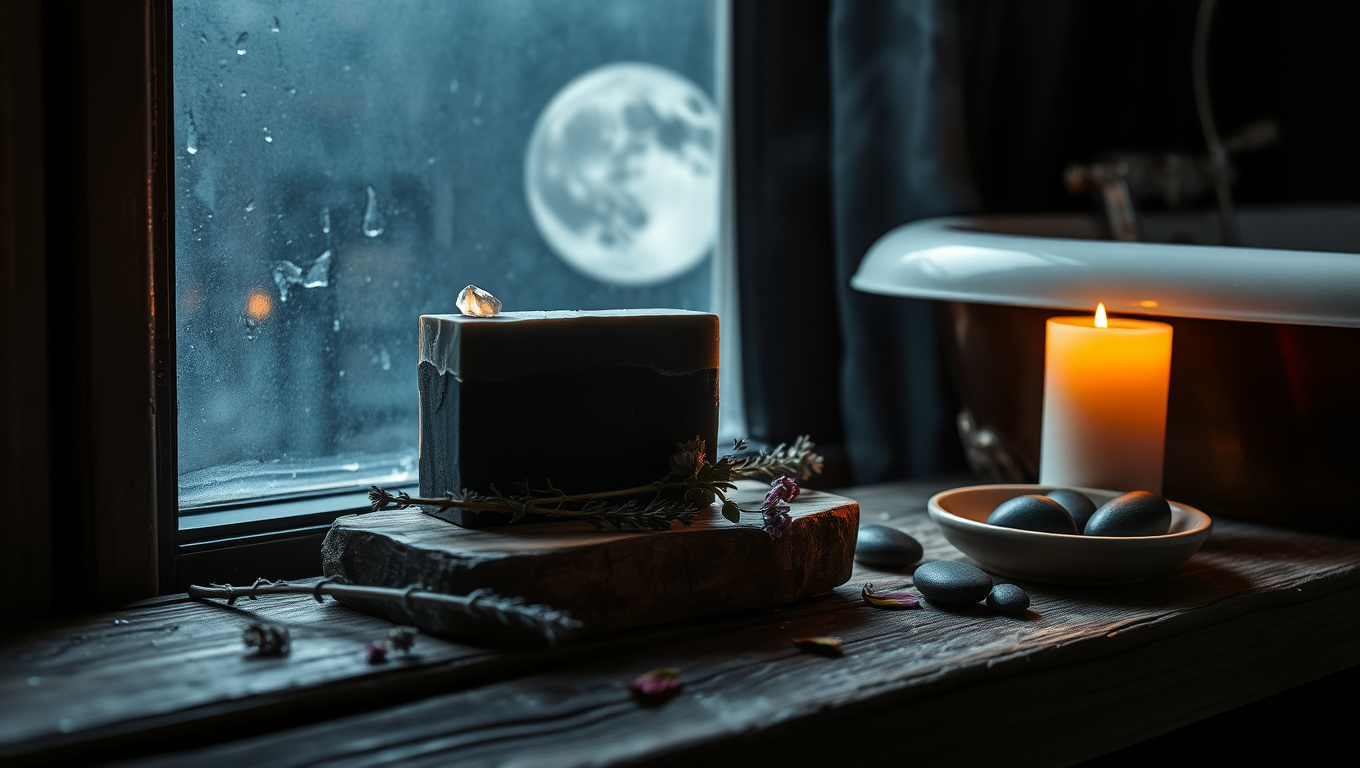
Start before the water runs. Clear the bathroom of clutter — or at least enough of it that the space doesn’t feel chaotic. You’re not staging a photo shoot; you’re making it easier for your nervous system to exhale. Light a candle. One is enough. If you have a window with moonlight coming through, open the curtain or the blind. You don’t have to see the moon directly; the light coming in is enough.
If you work with a journal, bring it to the bathroom door. You may want it after. If you burn incense or use a diffuser, this is the time to get it going. Frankincense and myrrh are traditional choices for this kind of ritual work. Cedar and lavender are grounding and familiar. Choose what you actually enjoy the scent of — forced ceremony tends to feel hollow.
Step Two: Set an Intention Before You Step In
This is the part that separates a bath from a ritual. Before you get into the water, pause for a moment and name — even just in your head — what this bath is for. It can be simple. “I’m releasing this month’s anxiety.” “I’m honoring how far I’ve come.” “I’m just here to breathe.” The intention doesn’t need to be elaborate or poetic. It just needs to be honest.
Some people write their intention on a small piece of paper and set it near the tub. Some people say it out loud. Some people just hold it quietly in their chest before stepping in. All of these work.
Step Three: The Bath Itself
Draw the water as warm as you find comfortable. If you like, add a handful of sea salt to the water — salt has a long folk history in cleansing and protective practices, and it also softens the bath water in a way you can actually feel on your skin. Dried botanicals like lavender, rose petals, or chamomile flowers can be floated in the tub for scent and atmosphere, though they make a bit of a mess and you’ll want to gather them up before draining.
Once you’re in, take a moment before reaching for the soap. Just breathe. Let the water do what water does. Then take your bar of handmade witch soap and work up a lather slowly, deliberately. Notice the scent as it blooms in the steam. Let it actually reach you. This is not the time to rush.
Lather your hands, your arms, your shoulders. There’s nothing mystically prescribed about which order you wash in — just move with attention rather than on autopilot. If thoughts come up, let them. You’re in a ritual bath, not a sensory deprivation tank. Thoughts are allowed. Just notice them and return, gently, to the scent in your hands and the warmth of the water.
Step Four: Rest in the Water
Don’t rush out. The temptation is always to finish the practical act of bathing and then exit as if you’ve completed a task. Instead, put the soap down and just be in the water for a few minutes more. Breathe the steam. Let the scent of the botanicals settle around you. This is where the ritual actually happens — in the quiet between doing and leaving.
If you want to visualize something during this time, keep it simple. Imagine the things you named in your intention dissolving into the water around you. Or imagine the moonlight coming through the window touching the surface of the bath. You don’t have to be good at visualization for this to feel meaningful. The act of trying is the act.
Step Five: After the Bath
Pat dry rather than rub — this is just good practice with handmade soap, since natural bar soaps leave a softness on the skin worth keeping. Wrap yourself in something warm. If you brought your journal, this is the right moment: write whatever comes up, without editing it. Full moon journaling is a long-standing practice for a reason. The combination of warm water, botanical scent, and candlelight tends to loosen things up in a way that makes for surprisingly honest writing.
Blow out your candle intentionally, rather than just forgetting to. It’s a small act, but it closes the ritual with the same awareness that opened it.
A Word on Caring for Your Handmade Soap Bar
Because Spellbound Grove’s soaps are made in small batches with natural oils and without synthetic preservatives, they benefit from a little care between uses. Keep your bar on a draining soap dish — one that lets water escape rather than pool underneath — so it dries properly between baths. A wet bar sitting in standing water will soften and dissolve faster than it should. A dry bar between uses will last considerably longer and maintain its scent beautifully.
If your bar has a crystal adornment on top, remove it gently before or after use and set it somewhere safe. Many people who work with ritual soap treat these stones as companions to the soap’s intention, cleansing them occasionally under running water or moonlight. That’s entirely up to you. It’s a nice practice, but it’s not required for the soap to smell wonderful and lather well.
Not Sure Where to Start? Try Before You Commit
If you’ve never used a Spellbound Grove bar before and aren’t sure which scent calls to you, there’s a genuinely low-stakes way in: the Free Soap Sample lets you choose one handcrafted sample bar — in your preferred scent and your choice of regular or nut-free formula — to try before committing to a full bar. It’s limited to one per customer, but it’s a real bar, really handmade, and a real way to experience what these soaps are actually like in your hands and in your bath.
There’s also a Build Your Sample Pack option if you want to compare two scents side by side — a practical choice if you’re torn between something like the smoky depth of Dark Alchemy and the gentler lunar warmth of Triple Moon Goddess.
Closing the Circle: Make the Moon Your Ritual Anchor
The full moon comes around roughly every 29.5 days. That’s about twelve or thirteen chances a year to build something consistent — a monthly ritual that costs very little, requires no special equipment, and asks only that you show up and pay attention. Over time, this kind of rhythmic practice can become genuinely grounding in a way that’s hard to manufacture any other way. You start to notice what shifts between moons. You develop a relationship with your own seasonal rhythms. You give yourself one evening a month that belongs entirely to you.
A bar of handmade witch soap is a small thing. But small things, chosen with care and used with intention, have a way of holding a lot. That’s what folk magic has always understood. Not that objects have power in themselves, but that we pour meaning into them through attention and repetition — and meaning, once poured, tends to stay.
If you’re ready to start, or if you want to refresh the ritual with something new, explore the handcrafted soaps and botanical goods at Spellbound Grove. Every bar is made in small batches, with real ingredients, by real hands — and with exactly this kind of evening in mind.