Where Forest Paths Meet the Lather of Something Ancient
There is a particular kind of person who pauses at the edge of a tree line, just long enough to breathe it in — the green, the damp bark, the faint sweetness of something decaying and becoming at the same time. That person understands, probably without being told, why a bar of handmade witch soap can mean more than clean skin. They get it. A scent is a doorway. A ritual is a rhythm. And a well-made thing, crafted slowly and with intention, carries something that a factory-pressed bar simply cannot.
Spellbound Grove was built on exactly that understanding. It lives at a crossroads — the place where folk herbalism meets modern craft, where an old story about a goddess brushes up against a cold autumn morning and a hot bath, where a hand-sewn label on a hoodie says something quietly true about who you are. The brand makes small-batch ritual soaps, botanical bath goods, and witchy apparel, and it does all three with a seriousness that never tips into pretension. It is cozy and earthy and a little wild. It smells like cedarwood and patchouli and cold night air.
This is the story of how those threads — folklore, the forest, and the way we dress ourselves for the life we actually want — are all woven together at Spellbound Grove, and why that weaving matters to so many people who have found their way here.
The Long History Behind Ritual Soap
Soap has never been just soap. Long before it was a commodity wrapped in plastic and stacked on drugstore shelves, washing was tied to meaning. In many folk traditions across Europe, Asia, and the Americas, the act of cleansing the body carried symbolic weight — it was about preparing yourself for something: a ceremony, a new season, a rite of passage, a prayer. Water and herbs were not incidental to those rituals. They were the ritual.
Botanical ingredients have been valued in folk practice for centuries for the way they smell, the textures they create, and the associations people built around them over generations. Lavender, for instance, has long been woven into European folk custom — hung in doorways, tucked under pillows, burned to mark transitions. Myrrh appears in ancient trade records from across the Middle East and Mediterranean and carries one of the oldest aromatic histories of any resin. Cypress has ties to mourning traditions in multiple cultures, but also to guidance and threshold-crossing — the kind of tree you plant at the edge of a sacred space.
When a small-batch soapmaker chooses these ingredients, they are not choosing randomly. They are reaching into that long thread of human meaning and pulling it forward into something you can hold in your hands, something that lathers and rinses and leaves your skin soft while your imagination does the rest.
What Makes a Soap a Ritual Soap?
A ritual soap is not just one that has an interesting name or a pretty stone pressed into the top. It is a bar that was made with a sense of purpose — where the scent combination was thought through, where the botanicals were chosen with some awareness of their folk associations, and where the act of using it can, if you let it, become a small anchor in your day. It is a bar that invites you to slow down, to notice what you are doing, to treat the ordinary act of washing as something worth being present for.
That is not mystical language for its own sake. It is just an honest description of what mindful craft can produce. A bar made in a large factory has no such consideration behind it. A bar made in small batches, by someone who actually cares what goes into it, is a fundamentally different object — even if the chemistry of saponification is the same.
The Botanicals at the Heart of Spellbound Grove’s Small-Batch Soaps
Walk through the scent profiles of Spellbound Grove’s soaps and you will find yourself walking through a kind of botanical garden at dusk — familiar in parts, strange in others, always worth exploring slowly.
Take Hecate’s Feline Friend, a bar built around cypress, lavender, clary sage, cedarwood, and patchouli. That combination is earthy, cool, and just slightly resinous — the kind of scent profile that makes you think of a dark forest just after rain, or a candle burning in a room full of old books. Clary sage in particular has a botanical quality that is difficult to describe without simply saying it smells like something growing and alive. These scents together feel intentional, like they were chosen not just to smell good but to conjure a mood.
Or consider Dark Alchemy, which layers myrrh, cypress, lavender, jasmine, rose, patchouli, cinnamon, and black pepper with a clear quartz adornment. This bar is more complex — the floral and the resinous working together, the warmth of cinnamon and pepper grounding what could otherwise float away into pure sweetness. It is the kind of scent profile you associate with something old and considered. These are not random notes. Each one has a long folk history, and together they create something that feels genuinely like witchy skincare rather than a product that simply borrowed the aesthetic.
Crystals, Stones, and the Weight of Adornment
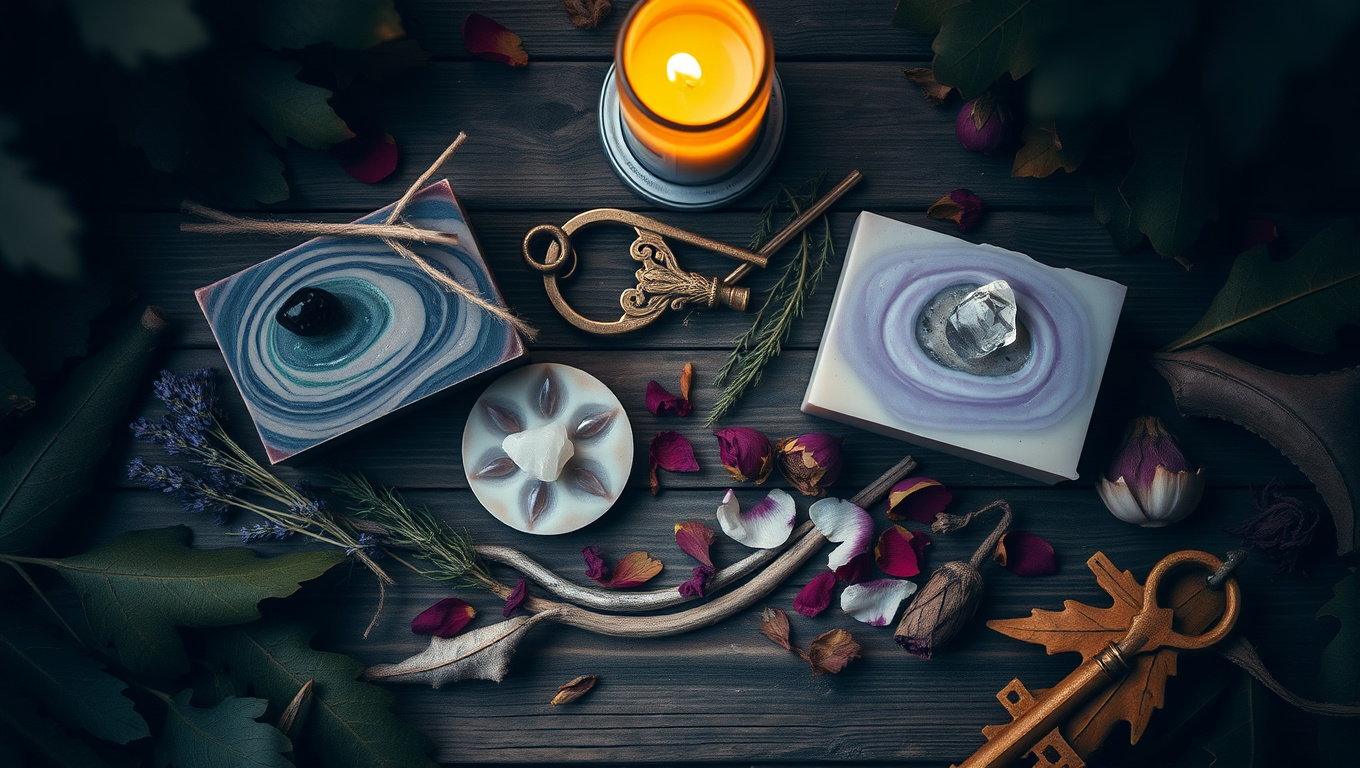
Many of Spellbound Grove’s soaps include a small crystal or mineral pressed into or placed on top of the bar. Prehnite on Hecate’s Feline Friend. Clear quartz on Dark Alchemy. Black obsidian on both Hollow Night and Shadow and Sage. Amethyst on Triple Moon Goddess. Citrine on Hex and Honeysuckle.
These are not decorations in the throw-away sense. Crystals and stones have been used in folk practice and symbolic traditions across many cultures for a very long time, and even if you have no particular relationship to crystal work, there is something honest about the choice to embed them. It is a way of saying: this bar is meant to be more than functional. It is an object worth looking at, worth keeping on your altar shelf or your bathroom windowsill, worth treating as something made rather than just manufactured.
Folklore as a Living Practice, Not a Costume
One of the things that can make “witchy” branding feel hollow is when it borrows the symbols without engaging with the stories. Hecate appears on a lot of labels these days — her torches and her keys have become almost shorthand for a particular aesthetic. But Hecate, in Greek tradition, is a goddess with genuine depth: associated with crossroads, with the moon in its dark phase, with knowledge that lives at the margins of conventional understanding. She is a protector of households and a guide through transitions. She is complicated, ancient, and worth taking seriously.
The Goddess Hecate soap at Spellbound Grove — with its notes of myrrh, cypress, lavender, jasmine, amber, and rose, and its antique key adornment — is clearly made by someone who has thought about this. The antique key is not just pretty. The key is one of Hecate’s traditional symbols. The cypress is a tree long associated with liminal spaces and the crossing of thresholds. The myrrh is ancient and ceremonial. This bar is doing something coherent. It is not dressing up in a borrowed costume.
That is what it means to use folklore as a living practice. It means learning enough to do it honestly, and then making something that reflects that learning in a way that other people can feel, even if they cannot quite articulate why.
Seasonal Living and the Wheel of the Year
Folk traditions in northern Europe and Britain developed a strong sense of seasonal rhythm — the idea that the year has distinct emotional and spiritual textures, and that it matters to acknowledge those shifts. Many people today, whether they identify as witches or not, find real comfort in that seasonal awareness. The return of autumn feels different from the height of summer. The dark months ask something different of us than the bright ones.
Spellbound Grove makes soap that honors this. Hollow Night is explicitly Samhain-inspired: pumpkin cider, mulled cider, chocolate amber, and smoky sandalwood, with a black obsidian adornment. It smells like October in the best possible way — warm and slightly dark, sweet and then grounded by wood smoke. Using it during the turning of fall into winter is a way of marking that transition, of giving the body something that says: I see this season. I am here for it.
Similarly, Fall Harvest opens with apple cinnamon and nutmeg before settling into blue spruce and frankincense — a Mabon-inflected bar, spiced and earthy, that feels like standing in an orchard at twilight. These are cottagecore soap qualities in the best sense: deeply rooted in the natural world, seasonal, unhurried.
The Craft of Small-Batch Handmade Soap
It is worth talking about what actually goes into making a bar of natural handmade soap, because the process is not simple, and the difference between a handcrafted bar and a commercial one is significant enough to justify the distinction.
True cold-process or hot-process soap is made by combining oils or fats with a lye solution, which triggers a chemical reaction called saponification. The resulting bar retains the natural glycerin that forms during this process — glycerin that commercial soap manufacturers often remove and sell separately. That retained glycerin is part of what makes handmade soap feel different against the skin. It is part of why a handcrafted bar has a different texture, a different lather, a different quality.
Small-batch production means a soapmaker can be genuinely selective about their oils, their botanicals, their fragrance and essential oil choices. It means they can make bars that would be impractical at scale — bars with crystal adornments, bars scented with complex layered notes, bars made with specific seasonal ingredients. It also means each batch has a slight uniqueness to it. That is not a flaw. It is evidence of something made by hand.
Caring for a Handcrafted Soap Bar
If you are new to natural handmade soap, there are a few small things worth knowing. Handcrafted bars, because they retain their glycerin, are more water-absorbent than commercial bars. This means they benefit from drying out between uses. A simple wooden soap dish with drainage, or even just a small dish that lets air circulate underneath the bar, will extend its life considerably. Keep it out of direct streams of water when not in use. Let it breathe. A well-cared-for bar will last longer than you might expect, and it will hold its scent better too.
If you receive a soap with a crystal adornment on top, you can leave it in place while you use the bar, or carefully remove it early on and keep it as a separate keepsake. Many people do the latter — the obsidian from Hollow Night on a windowsill, the rose quartz from a Love Spell bar on an altar or bedside table.
Building a Simple Ritual Around Your Handmade Witch Soap
You do not need a full ceremonial setup to bring some intentionality to your bath or shower. A small ritual can be genuinely simple — it just requires a moment of attention before you begin.
Light a candle. Put your phone down somewhere you cannot reach it. Run water that is the temperature you actually want, not just whatever comes out first. Hold the soap in your hands for a moment before you use it. Notice what it smells like. Notice how the lather changes as the bar gets wet.
If you are drawn to moon timing, a full moon bath ritual is one of the oldest and simplest forms of seasonal self-care — the idea being that the full moon is a natural point of completion and release, a good time to wash away what you have been carrying. The Triple Moon Goddess soap, with its lavender, frankincense, myrrh, and vanilla, and its amethyst adornment, is perfectly suited to this kind of evening ritual. The scent is soft and powdery-floral — the kind that lingers in a warm bathroom long after the candle goes out.
For something more grounding — a bath before journaling, or before a difficult conversation, or at the end of a week that asked a lot of you — Shadow and Sage offers vanilla, cedarwood, vetiver, and firewood, anchored with black obsidian. It is a bar for settling. For coming back to yourself. The scent has that quality of being rooted to something solid, which is exactly what shadow work soap should feel like — not dramatic, just steady.
Where Fashion Meets the Forest: Witchy Apparel as Expression
Spellbound Grove does not stop at the bathroom shelf. The apparel line is a natural extension of the same ethos: wear what feels true, wear what is made with care, wear what says something honest about who you are and what you find beautiful.
The Spellbound Grove Oversized Boxy Tee is a good example of how this works. It is soft and roomy — built for real life, not a photoshoot — and it carries a muted gold sigil of a rooted tree on the chest, with vintage-style lettering on the back reading “Where Magic Comes To Life.” There is nothing shouting about it. It is the kind of shirt you wear when you want to feel like yourself on a slow Saturday, when the autumn air is just starting to cool and you want something that fits the mood of the day.
The mystical apparel at Spellbound Grove — from the Mystical Witch Hoodie to the Bone Collector Crew Tee — follows the same principle. These are pieces for people who find beauty in the strange and the earthy, who have an affinity for ravens and roots and old symbols, who dress themselves the way they live: with a little wildness, a little intention, and a strong preference for real over performative.
Witchy fashion, when it is done well, is less about a costume and more about a sensibility. It is the person who reaches for the darkest color in the closet on an overcast November morning because it feels right. It is the hoodie with a raven on it worn to the farmers market on a Sunday. It is knowing what you love and wearing it without apology.
The Full Picture: What Spellbound Grove Offers Someone Who Actually Lives This Way
For someone who finds meaning in the turn of seasons, who reads about folk herbalism not as an academic exercise but because it feels genuinely relevant to their daily life, who wants their bath to be a moment of presence rather than a chore, and who wants to wear clothes that reflect an inner life — Spellbound Grove is not trying to sell them something they do not need. It is trying to make the things they were already reaching for, and make them well.
The soaps are handcrafted soap in the truest sense — small batch, botanically considered, scented with real care, adorned with stones that have folk meaning. The apparel is for daily life, not just special occasions. The whole collection, from a full bar of goddess soap to a sample pack you can try before committing, is built around the same quiet premise: the ordinary can be made extraordinary not through excess, but through attention.
If you are curious about any particular bar — if you want to know what Dark Alchemy smells like before buying a full bar, or if the Siren’s Song notes of jasmine and blue spruce sound like something you want to fall asleep smelling — Spellbound Grove offers a free soap sample (one per customer) so you can try before you commit. There is also a Build Your Sample Pack option that lets you choose two sample-sized bars from the collection — a good way to compare profiles side by side.
Finding Your Bar: A Note on Choosing Handmade Witch Soap
The best way to choose a handmade witch soap is honestly pretty simple: follow the scent profile toward something that matches the mood you want to create. Not the mood you think you should want, or the most aesthetically dramatic name, but the actual scent combination that sounds like it belongs in your bathroom, in your ritual, in your life right now.
If you want warm and spiced and autumnal, Fall Harvest or Hollow Night. If you want something complex and resinous and a little dark, Dark Alchemy or Goddess Hecate. If you want something bright and floral with some depth, Love Spell with its ylang ylang, jasmine, and rose quartz. If you want to feel like you are standing on a shoreline in the evening, Siren’s Song. If you want the forest, Hecate’s Feline Friend or Witch’s Brew.
And if none of the existing bars are quite right, Spellbound Grove also offers a Custom Soap option — where you choose the scent blend, colors, appearance, and adornment. A bar made specifically for your ritual, in your image. That is a rare thing in the world of handcrafted soap.
Closing: The Grove Is Waiting
There is a version of this kind of brand that would shout at you — that would promise transformation and use every possible mystical superlative and leave you feeling vaguely sold to. Spellbound Grove is not that. It is quieter. It trusts that if you are the kind of person who has read this far, you already understand why a bar of soap can be more than a bar of soap. You already know that the way you dress yourself matters. You already find something real in the turn of a season or the smell of cedarwood on a wet morning.
All Spellbound Grove is doing is meeting you where you already are — with good ingredients, honest craft, and a genuine love for the earthy and the enchanted.
If any of this resonates, take your time and explore the handcrafted soaps and witchy goods at Spellbound Grove. There is no rush. The grove will be here when you are ready.