
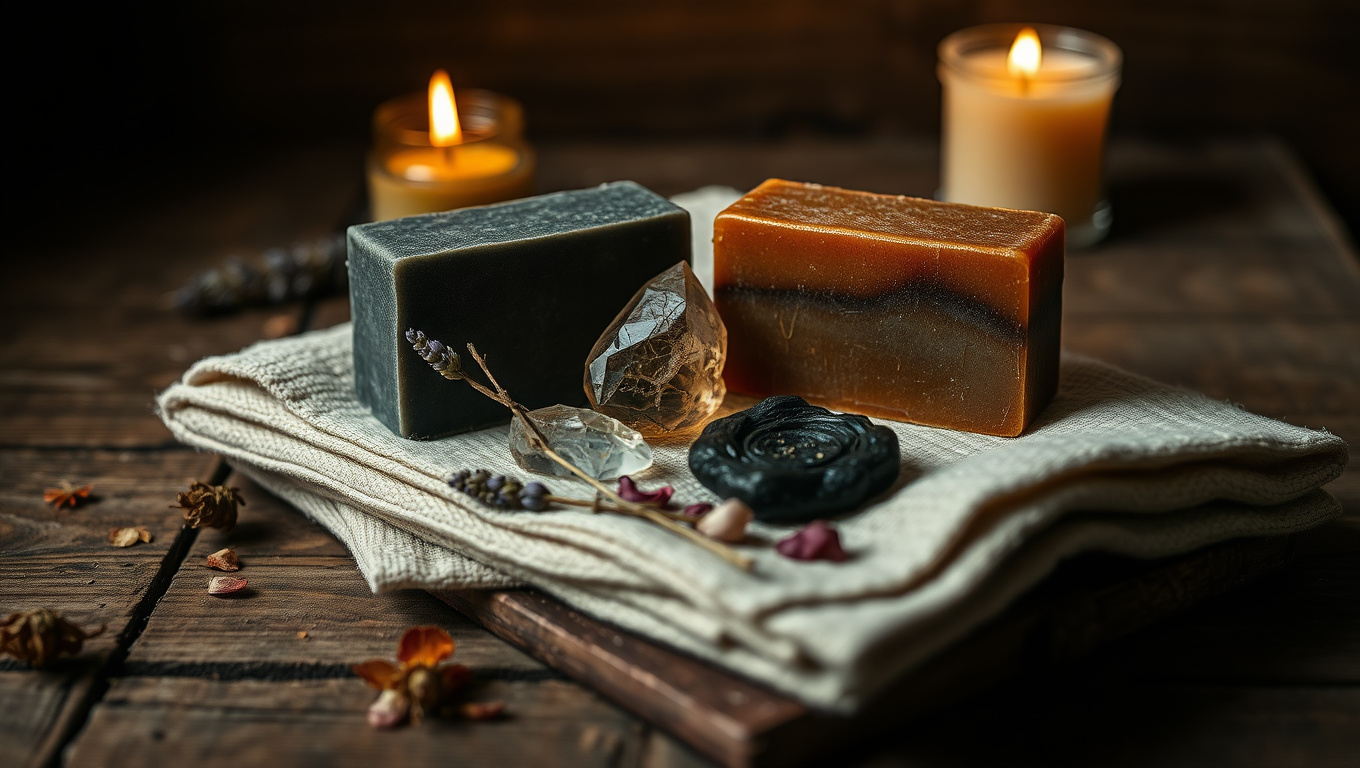
When Witchy Self-Care Starts Feeling Like a Performance
There’s a particular kind of fatigue that comes from trying to make your spiritual life look a certain way. Maybe you’ve felt it: the pressure to have the right candles, the right crystals arranged just so, the perfect playlist humming in the background before you can even begin. You spend more time setting up the scene than actually being in it. And then, somewhere in the middle of all that staging, the quiet magic you were reaching for slips away.
Handmade witch soap, botanicals, ritual baths — these things genuinely matter to a lot of people who walk a more intentional, earth-connected path. But the internet version of witchy self-care has a way of making it all feel like an aesthetic to perform rather than a practice to live. This article is about pulling that back. About what it actually looks like to build ritual into a real life — one that has deadlines and dishes and days when everything goes sideways.
The good news is that meaningful practice rarely requires more stuff or more time. It usually requires less of both, and more actual attention. A single bar of well-crafted handmade witch soap, held under warm water with a moment of real presence, can do more for your sense of groundedness than an elaborate setup you resent putting together.
What “Ritual” Actually Means Outside the Instagram Aesthetic
The word ritual gets used loosely, and that’s not entirely a bad thing. But it helps to know what it’s pointing at. A ritual, at its simplest, is a repeated act done with intention — something you do deliberately, not just habitually. The distinction sounds small. It isn’t.
Washing your face every night is a habit. Washing your face at the end of the day and choosing to let the water carry away whatever heaviness you’re holding — that’s a ritual. Same action, different quality of attention. That shift doesn’t require candles or incantations. It requires only that you actually show up for the moment instead of letting it happen on autopilot.
Folk traditions across many cultures have long understood this. Bathing has been part of spiritual practice in countless traditions — not because water is magic in a literal sense, but because the act of cleansing, when done with awareness, creates a felt sense of transition. You are different, in some small way, after a bath taken with intention than after one taken while mentally composing your grocery list.
The Problem with “More Is More” Spirituality
There’s a version of witchy culture that equates depth with accumulation. More tools, more correspondences memorized, more elaborate sabbat celebrations. And while there’s nothing wrong with enjoying those things if they genuinely speak to you, they can quietly become a barrier. When your practice only feels valid if everything is perfectly in place, you end up practicing far less than you could.
The most grounded practitioners I’ve encountered tend to have a few simple things they return to again and again. A preferred tea. A small altar that doesn’t change much. A bar of ritual soap that has become as much a part of their morning as the light through the window. Consistency and attention — not complexity — are what give a practice its weight.
How Handmade Witch Soap Becomes Part of a Real Practice
There’s a reason small-batch, handcrafted soap has found its way into so many modern witchy self-care routines. It isn’t just the ingredients, though those matter. It’s the whole object: the weight of it in your hand, the scent that rises with the steam, the fact that someone made it deliberately and put real thought into what it contains and what it evokes.
Mass-produced soap is functional. A bar of handmade witch soap made with botanical ingredients and crafted in small batches is something you can actually be present with. The scent anchors you. The lather is different — richer, more complex. The ritual soap bar on your shower shelf becomes a cue, the way a specific song can shift your whole mood just by starting to play.
The craft of traditional cold-process soapmaking — which is what most serious small-batch makers use — takes weeks from pour to cure. Oils are blended carefully. Botanicals are chosen for how they perform in the formula and what they bring to the sensory experience. A good ritual soap bar isn’t just scented; it’s considered. That consideration is something you can feel.
Choosing a Soap That Actually Suits Your Practice
One of the quietest pleasures of building a witchy skincare practice is choosing tools that genuinely resonate with where you are — not where you think you’re supposed to be. If you’re drawn to shadow work, to the darker months, to practices of release and honest self-examination, a soap heavy with earthy, smoky notes like vetiver, cedarwood, or firewood will feel more aligned than something bright and floral. If you’re working with themes of love, creativity, or joy, you’ll naturally gravitate toward warmth and sweetness.
Scent has a powerful relationship with memory and mood that most of us experience instinctively. Folk herbalism has long drawn on this — certain plants and resins have been used in ceremonial and spiritual contexts across cultures for centuries, not because of chemistry charts but because of what they evoke. Frankincense in sacred spaces. Lavender in folklore associated with calm and protection. Myrrh in rites of deep transition. These associations didn’t come from nowhere.
Spellbound Grove’s Shadow and Sage is a good example of a soap built for this kind of intentional use. Its notes of vanilla, cedarwood, vetiver, and firewood are genuinely grounding — the kind of scent profile that signals to your nervous system that something quieter is beginning. It’s described as being made for rituals of release, and when you use it that way — deliberately, with that intention in mind — the ordinary act of bathing becomes something more.
For those drawn to more layered, resinous scents with an air of ancient ceremony, Dark Alchemy carries notes of myrrh, cypress, lavender, jasmine, rose, patchouli, cinnamon, and black pepper, with a clear quartz adornment resting on top. It’s a complex bar — warm and a little mysterious — ideal for moonlit baths or daily rituals when you want to call yourself back to your own center.
Building a Simple, Sustainable Ritual Self-Care Practice
Sustainable is the word that often gets left out of conversations about witchy self-care. A practice you can keep is worth infinitely more than a practice that looks beautiful and lasts three weeks. Here’s what actually tends to work for people living full, complicated lives.
Start with What You Already Do
You already bathe. You already wash your hands. You already have some kind of morning or evening routine, even if it’s loose. The most natural place to introduce ritual is inside the structure that already exists. Choose one moment — just one — and decide to do it differently. With attention. With something that smells good and was made well. That’s genuinely enough to start.
A shower taken with a carefully chosen natural soap bar, with the intention of washing away whatever you’re carrying from the day, is a legitimate spiritual act. It doesn’t need a moon phase calendar to validate it, though you might find, over time, that you naturally start to notice when the full moon falls and want to make that particular evening bath something a little more intentional.
A Simple Full Moon Bath Ritual You Can Actually Do
Full moon bath rituals show up across many folk and contemporary witchcraft traditions, and there’s something genuinely appealing about using a visible, recurring natural event as a marker for self-reflection and renewal. Here’s a version that requires almost nothing beyond a bathtub and a bar of ritual soap.
- Light one candle if you have one. It doesn’t have to be special. Any candle will do.
- Fill the tub with water as warm as you like. Add a handful of sea salt if you have it — plain, no additives.
- Choose a soap that fits your intention for this moon cycle. Something earthy and grounding if you’re releasing something. Something sweeter if you’re welcoming something new.
- Before you get in, take thirty seconds to state — out loud or silently — what you’re letting go of and what you’re making space for. Keep it simple and honest.
- Bathe slowly. Actually notice the scent of the soap, the warmth of the water, the feel of the lather. Don’t think about your to-do list.
- When you drain the tub, watch the water go. Let that be the visual close of the ritual — what you named, leaving with it.
That’s the whole thing. No special equipment, no memorized words, no performance. Just attention and intention, which are, honestly, the only ingredients a ritual ever truly needs.
Working with Scent as a Daily Anchor
One of the most practical things you can do to make witchy self-care feel real rather than theatrical is to use scent consistently and intentionally. Choose a soap or bath good for a specific purpose — morning energy, evening release, self-love work, shadow journaling — and use it only for that purpose. Over time, your brain will begin to associate that scent with that particular quality of attention, and the ritual practically starts itself.
This is why having more than one bar on rotation can be genuinely useful. Not for the sake of accumulation, but for the sake of giving each practice its own sensory identity. The Love Spell soap — with its notes of ylang ylang, sweet orange, rose, jasmine, and vanilla, finished with a rose quartz adornment — has a warmth and sweetness that lends itself naturally to self-love ritual or quieter, more tender evenings. It smells the way a love letter feels. Using it consistently in moments you’ve set aside for softness and self-regard gives it meaning beyond its ingredients.
What Witchy Skincare Looks Like When It’s Honest
Witchy skincare at its best is botanical skincare taken seriously. It’s paying attention to what you put on your skin and why. It’s caring about the quality of ingredients, the ethics of sourcing, the craft of the person who made the thing. It’s choosing natural soap bars over ingredient lists you can’t parse. That’s not mysticism — that’s just good sense with a little enchantment layered on top.
Small-batch handcrafted soap made with real oils — the kind that goes through a weeks-long curing process — behaves differently on skin than its commercial counterpart. It retains more of the glycerin that forms naturally during saponification, which is what gives a good handmade bar that characteristic feel. The botanicals included in a well-made ritual soap are chosen for what they actually contribute to the bar — in scent, in texture, in the overall sensory experience of using it.
This is worth knowing, not because it should replace your intuition about what you love, but because it helps you understand what you’re holding. A bar of handmade soap for witches, made by someone who cares about the craft, is a small, real thing with genuine quality behind it. Treating it as part of a meaningful practice isn’t superstition. It’s simply paying attention.
Letting Go of the Need to Get It Right
The thing that makes witchy self-care performative, in the end, is usually the pressure to do it correctly. To observe every correspondence, to never miss a moon phase, to have the most authentic practice. That pressure is the opposite of what most genuine spiritual practice is pointing toward.
You don’t have to use your ritual soap on the right moon. You don’t have to finish every bar in any particular order or remember every botanical association. You just have to show up, pay attention, and let the moment be what it is. Some of the most meaningful ritual experiences happen on ordinary Tuesday evenings when nothing was planned and everything just quietly clicked into place.
Making Witchy Self-Care Your Own
The most honest advice anyone can give you about building a witchy self-care practice is this: start with what you actually love and build from there. If you love the smell of dark resins and woodsmoke, that’s your thread. If you love something bright and botanical, follow that. Your practice should feel like coming home to yourself, not like following someone else’s directions.
If you’re not sure where to start, there’s real value in sampling before committing. Spellbound Grove offers a free soap sample so you can try a bar before you invest in a full one, which is exactly the kind of low-pressure way to begin. You might also consider the Build Your Sample Pack, which lets you choose two sample-sized soaps from the collection — a genuinely useful way to find out which scent profiles feel most aligned with your practice before committing fully.
Seasonal living, folk herbalism, handmade goods, and the quieter side of a witchy lifestyle all share one thing: they ask you to slow down and pay attention. To the season you’re actually in. To the ingredients in what you’re using. To the quality of your own presence in ordinary moments. That’s the practice. Everything else — the gorgeous soaps, the botanicals, the small rituals — they’re just the beautiful scaffolding around something much simpler and much older.
A Final Word on Handmade Witch Soap and the Practice Worth Having
A practice worth having is one you actually return to. Not one you photograph and abandon, not one that makes you feel behind when you miss a day. The most grounded, most genuinely witchy self-care looks like ordinary things done with extraordinary attention: a bath, a morning, a bar of handmade witch soap that smells like somewhere you want to be.
If you’ve been looking for a way in — or a way back — this is it. Small, real, honest, and yours. You don’t need to perform anything for anyone. You just have to mean it.
When you’re ready to find a bar that actually fits the ritual you’re building, explore the handcrafted soaps and botanical bath goods at Spellbound Grove. Every bar is made in small batches, with real ingredients and genuine care — the kind of thing that’s worth building a practice around.