
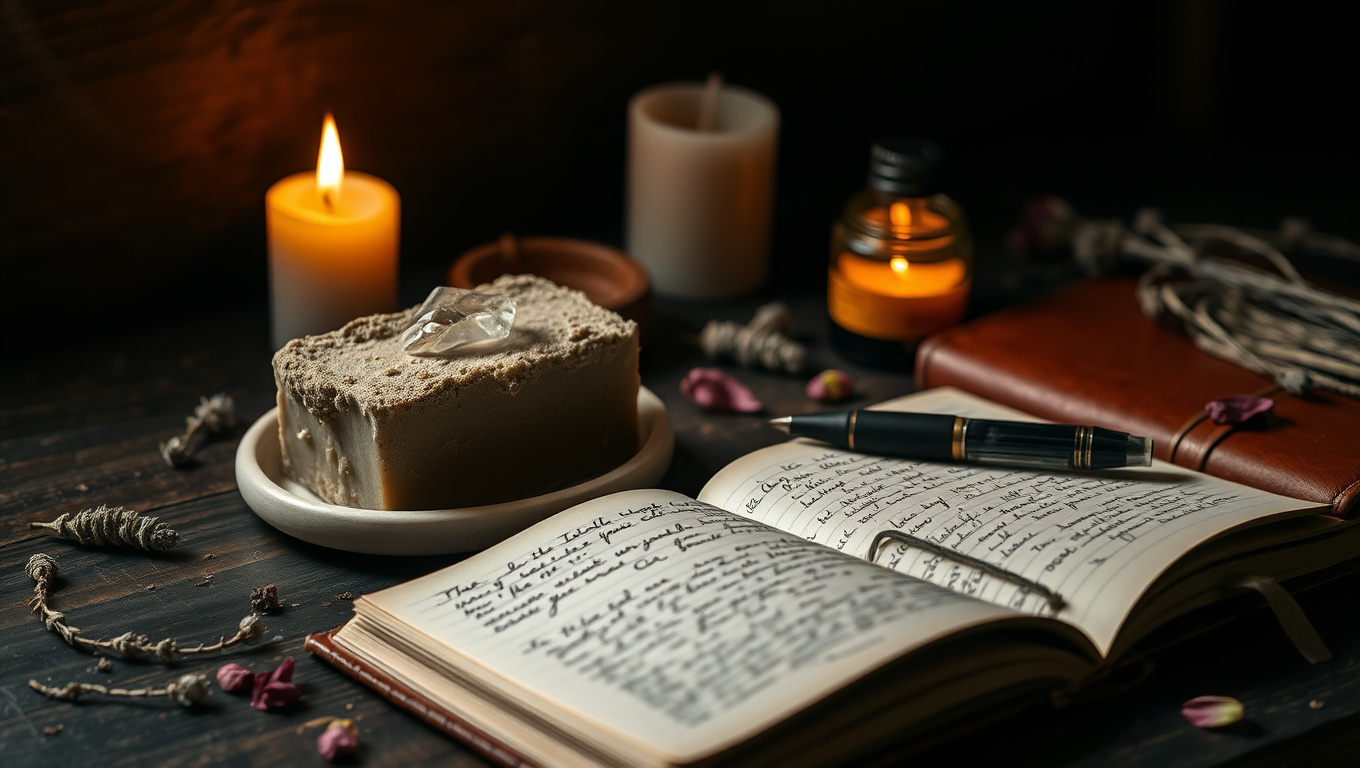
The Simple Power of Soap and a Blank Page
There’s a particular kind of quiet that settles in when you light a candle, press your pen to a blank page, and let yourself actually think. Journaling has been a cornerstone of reflective practice for a long time — not because it’s complicated, but because it works. Writing slows the mind down in a way that most things don’t. And yet, even the most devoted journal-keepers know how easy it is for the practice to go flat. The notebook sits unopened. The words don’t come. The ritual stops feeling like one.
What can shift that? A lot of times, it’s something sensory. A smell that signals transition. Water that helps you cross from one mental space into another. This is where handmade witch soap enters the picture — not as a gimmick, but as a genuine tool for building the kind of before-and-after that makes a ritual feel distinct from just another item on your to-do list. A bar of botanical soap, used with intention before you sit down to write, can become the threshold between the noise of the day and the quieter self you’re trying to hear on the page.
This isn’t about making things overly elaborate. You don’t need an altar, an hour of free time, or a perfectly curated aesthetic. You need a few minutes, a bar of soap that means something to you, some warm water, and something to write with. That’s genuinely enough.
Why Scent Is the Fastest Way Into a Ritual Mindset
Of all the senses, smell is the most direct line to memory and mood. It bypasses a lot of the filtering the brain does with sight or sound and lands somewhere older, more instinctive. Folk traditions across many cultures have used scent — herbs burned, oils applied, flowers strewn — as a way of marking time, honoring transitions, and signaling to the body that something is beginning or ending. That’s not mysticism for its own sake. It’s practical wisdom about how human beings actually work.
When you use the same scent consistently at the start of a journaling practice, your brain begins to associate it with that state of openness and inward focus. Over time, the scent itself becomes a kind of cue. You lather up, you rinse your hands, and something in you knows: this is the moment. We’re doing this now.
Choosing a Ritual Soap That Matches Your Intention
Not every bar of soap is created for the same mood, and that’s worth thinking about when you’re pairing one with journaling. The scent notes matter. So does the feeling you want to cultivate before you write.
If your journaling tends toward shadow work — the kind of writing that asks hard questions, sits with grief, or looks honestly at things you’ve been avoiding — you want something grounding and a little earthy. Something that says: you can go deep here, and you’ll be okay. Shadow and Sage from Spellbound Grove is built for exactly this kind of moment. It carries the scent of vanilla, cedarwood, vetiver, and firewood — warm, rooted notes that feel like being held steady while you do hard inner work. The product description even calls it out as ideal for use before divination and journaling, which isn’t an accident. That’s a bar that was made with this kind of practice in mind.
If your writing is more about exploration — moon journaling, gratitude practice, dreaming into what you want to call forward — something with a lighter, more luminous quality might serve better. The Triple Moon Goddess bar, scented with lavender, frankincense, myrrh, and vanilla, has a soft floral-powdery quality that feels expansive rather than heavy. It’s the kind of scent that feels like opening a window.
For a self-love journaling practice — the kind where you write yourself letters, document what you’re proud of, or reconnect with your own warmth — something rosy and sweet makes sense. The Love Spell bar, with its blend of ylang ylang, sweet orange, rose, jasmine, and vanilla, is all softness and warmth. It smells like something you’d want to return to. And that’s the whole point.
How to Build the Ritual: A Practical Guide
This is the part people sometimes skip — the actual how. Knowing you want to combine journaling with a ritual soap practice is one thing. Having a real structure to follow, at least at the beginning, is another. Here’s a simple framework you can adapt to your own schedule, season, or intention.
Step One: Set the Space Before You Wash
Before you ever touch the soap, take thirty seconds to prepare your writing space. Set out your journal and pen. Light a candle if that appeals to you. Close the tab you had open on your phone. You’re not doing this to be precious about the ritual — you’re doing it because having the space ready means you don’t have to think about it later. When you come back from washing your hands, you can simply sit down and begin.
Step Two: Wash With Attention
This sounds almost too simple. But there’s a real difference between washing your hands absent-mindedly while you think about something else and washing your hands as a deliberate act of transition. Use warm water. Take your time lathering. Notice the scent of the soap — actually notice it. Breathe in slowly. Let yourself feel the warmth of the water.
In a lot of folk practice, water is associated with cleansing that goes beyond the physical. Whether you hold that belief literally or metaphorically, there’s something useful in treating the act of washing as a symbolic threshold: this is where I leave the noise of the day, and cross into the quieter space of my own inner world. Even a secular journaler can borrow that framing and find it genuinely useful.
Step Three: Come to the Page Still Damp and Present
Don’t let too much time pass between washing and writing. You’ve just grounded yourself — use that. Sit down, open your journal, and begin before the moment fades. You don’t need a prompt. You don’t need to know what you’re going to say. The first sentence can simply be: “I just washed my hands with something that smells like cedarwood and firewood, and I’m here now.” That’s enough of a beginning.
Step Four: Close the Ritual Intentionally
When you finish writing, close your journal with a small deliberate gesture. Blow out the candle if you lit one. Take one more breath. You don’t have to make this elaborate — a single conscious moment of acknowledgment is enough. What you’re building, over time, is a shape: a beginning, a middle, and an end that your nervous system starts to recognize and trust.
Pairing Ritual Soap With Seasonal Journaling
One of the loveliest things about working with small-batch, handmade witch soap is that many bars are made with seasonal intention. The scent palette shifts. And this maps beautifully onto seasonal journaling — the practice of writing in tune with the wheel of the year, reflecting on what’s growing, what’s fading, what needs to be released or welcomed.
In the darker months — October, November, deep winter — journaling tends to turn inward. Shadow work, ancestor reflection, sitting with the uncomfortable. This is the season for heavier, smokier, more grounding scents. Patchouli. Cedarwood. Sandalwood. Myrrh. These are the notes that feel appropriate when the world is contracting and the work is internal.
In spring and early summer, journaling often shifts toward intention-setting, dreaming forward, celebrating small growth. Lighter botanicals — bergamot, honeysuckle, citrus, floral notes — match that energy. A bar like Hex and Honeysuckle, with its blend of bergamot, honeysuckle, frankincense, and cinnamon leaf, has that quality of something bright and a little wild. It smells like a journal entry that starts with a question and ends with a plan.
You don’t have to change your soap every month. But choosing a bar that resonates with where you are seasonally — in the calendar and in your own inner life — adds another layer of coherence to the ritual. Everything starts to rhyme.
The Full Moon Journaling and Handmade Witch Soap Ritual
If you only do this once a month, a full moon bath ritual paired with journaling is one of the most satisfying ways to mark time intentionally. The full moon has been used across many cultures as a natural point of reflection — a moment to take stock of what has grown, what is complete, and what is ready to be released. Journaling on the full moon gives that reflection a tangible form. The soap grounds you in your body before you go inward on the page.
On the night of the full moon, draw a warm bath or simply set aside ten quiet minutes at a sink or bath basin. Use your chosen ritual soap — something that feels aligned with what you’re sitting with that month. Wash slowly. Let the scent do its work. Then, still wrapped in the warmth of that small ceremony, sit down with your journal.
Some questions worth writing into on a full moon:
- What came to fruition this month that I didn’t fully acknowledge?
- What am I ready to let go of — a habit, a worry, a story I’ve been telling myself?
- What do I want to carry forward into the next cycle?
- What does my body know right now that my mind is still catching up to?
You don’t have to answer all of them. Even one can open something real.
A Few Practical Notes on Caring for Your Handmade Soap Bar
Handmade, small-batch soaps are made differently than commercial bars, and they deserve slightly different treatment. Most are made with a cold-process or hot-process method using natural oils and butters, which means they’re richer and more sensitive to prolonged water exposure than factory-made bars.
Keep your bar on a draining soap dish — one that lets air circulate underneath. This prevents the bar from sitting in pooled water, which would cause it to soften and waste faster. Between uses, let it dry completely. A well-cared-for handmade bar lasts longer than you’d expect and maintains its scent much better when it’s allowed to dry out between washes.
If you’re new to natural handmade soap and not sure where to start, Spellbound Grove offers a Build Your Sample Pack — two sample-sized bars you choose yourself from the full lineup. It’s a low-commitment way to figure out which scents actually speak to you before you commit to a full bar. There’s also a free soap sample available, one per customer, which is about as low-stakes as an introduction to a ritual practice can get.
What Builds Over Time
Here’s the thing about pairing a sensory anchor like handmade witch soap with a journaling practice: the first time you do it, it might feel a little self-conscious. The ritual is new, the habit isn’t formed yet, and you’re still thinking about the mechanics. That’s fine. That’s how every practice starts.
What happens after a few weeks — or a few moon cycles, if you’re working seasonally — is subtler and more interesting. You start to notice that the smell of that particular soap does something to your internal weather. You sit down to write with more ease. The page feels less like a blank wall and more like a door you know how to open. The water and the scent have done their work, quietly, every time.
That’s what ritual is, at its most honest: a repeated act that, over time, becomes its own kind of shorthand. A way of telling your body and mind: we’re going somewhere now. Pay attention.
Journaling can hold so much — grief, gratitude, confusion, ambition, wonder, the small things that happen on a Tuesday that you’ll want to remember. Giving it a proper beginning, one that involves your senses and your hands and something that smells like the earth or the night sky or a coming storm, makes the writing that follows feel more true somehow. More deliberate. More yours.
Finding Your Handmade Witch Soap Ritual Starting Point
If any of this sounds like something you want to try, the easiest place to start is simply with a scent that calls to you. Don’t overthink it. Think about what your journaling tends to be about — what you’re working through, what you’re reaching toward — and let that guide you toward a bar that fits. Earthy and grounding if you need steadiness. Floral and luminous if you need to open up. Warm and sweet if you need to be gentler with yourself.
You can explore the full collection of handcrafted ritual soaps at Spellbound Grove and take your time. Each bar is made in small batches with real botanical notes and a genuine sense of intention behind it. They’re the kind of soaps you notice when you use them — which is exactly what you want for the beginning of a practice that asks you to pay attention.
Start small. Start simple. Just wash your hands before you open your journal, with something that smells like it means something. See what changes.