The Triple Moon Symbol and What It Actually Means
There is something almost magnetic about the triple moon. You have probably seen it — three moon phases arranged in a row, the crescent waxing on the left, the full moon full and bright at center, the crescent waning on the right. It appears on jewelry, altar cloths, pottery, candles, and yes, on handmade witch soap. But what does it actually mean? And where did it come from?
The honest answer is layered, a little complicated, and far more interesting than the short version most people hear. The triple moon as a spiritual symbol is relatively modern in its current form, but it draws on something genuinely old — the human tendency to see the moon as feminine, cyclical, and alive with meaning. Understanding that difference, between what is ancient and what is modern, does not diminish the symbol. If anything, it makes it richer.
This is also a symbol that has found a natural home in witchy self-care — in the slow, intentional kind of bathing and ritual that many people have returned to as a way of marking time, honoring transitions, and simply feeling more present in their own bodies. That connection between symbol, season, and the sensory world of herbs and water is worth exploring carefully.
Roots in the Goddess and the Lunar Cycle
The moon has been personified as feminine across an enormous range of cultures and time periods. This is not a single tradition — it is something that emerged independently in many places, from ancient Greece to Mesopotamia to pre-Christian Europe. What those traditions share is the recognition of the moon’s cyclical nature: it waxes, it peaks, it wanes, it disappears, and it returns. That rhythm mirrors things humans have always found meaningful — growth, fullness, release, and renewal.
The Three Phases and What They Represent
In contemporary Wicca and broader modern witchcraft, the triple moon is most commonly understood as representing three aspects of the Goddess, sometimes called the Maiden, the Mother, and the Crone. Each corresponds to a lunar phase:
- The Waxing Crescent (Maiden) — associated with beginnings, curiosity, freshness, and the energy of something new taking shape.
- The Full Moon (Mother) — associated with fullness, abundance, creative power, and the peak of a cycle.
- The Waning Crescent (Crone) — associated with wisdom, release, endings, and the kind of deep knowing that comes only with time and experience.
This framework became widely known through the work of Gerald Gardner and Doreen Valiente in mid-twentieth century Britain, and later through writers like Starhawk, whose 1979 book The Spiral Dance brought the triple goddess concept to a much wider audience. It is worth being honest about this: the triple moon symbol as it is used today is largely a product of the modern Wiccan revival, not a direct inheritance from one continuous ancient tradition. But the ideas it encodes — that femininity is multiple, that cycles are sacred, that wisdom comes through experience rather than only through youth — those ideas resonate deeply and draw on genuine cross-cultural patterns of thought.
Hecate and the Crossroads of the Moon
One figure who appears again and again in discussions of the triple moon is Hecate. In ancient Greek religion, Hecate was a complex goddess — associated with the night, with crossroads, with the moon (especially in her later syncretized forms), with dogs, with torches, and with the boundary places between worlds. She was sometimes depicted in triple form, three bodies standing back to back, each facing a different direction at the crossroads.
Whether Hecate was always explicitly lunar or became so through later cultural layering is a question scholars still discuss. What is clear is that by the Hellenistic period, she was frequently connected to the moon and to the phases of transformation. In modern witchcraft, she is strongly associated with the Crone aspect of the triple goddess — the keeper of thresholds, the one who holds the lantern in the dark, the guardian of what is hidden and what is waiting to be known.
That image — a figure at a crossroads, holding a light — is one reason Hecate continues to feel relevant to people working with the triple moon symbol today. There is something deeply human about the crossroads as a metaphor. We all arrive there. We all have to choose a direction, often without knowing what lies ahead.
The Triple Moon in Modern Witchy Practice
For many people today, the triple moon is not primarily a theological statement. It is a reminder — a prompt to pay attention to cycles. To notice where you are in your own rhythms, not just the moon’s. Are you in a beginning? A moment of fullness? A time of releasing what no longer fits?
This kind of cyclical self-awareness is at the heart of what many people call witchy lifestyle or ritual self-care. It is less about belief in the literal and more about using symbolic frameworks to stay present. The moon is genuinely observable. Its phases are real. And using those phases as a loose structure for intention-setting, reflection, and renewal is something a lot of people find genuinely grounding — whether or not they identify as witches in any formal sense.
The Full Moon Bath Ritual
One of the most popular modern practices associated with the triple moon is the full moon bath — a slow, intentional soak taken around the time of the full moon. The idea is simple. You are setting aside time. You are marking the peak of a cycle. You are doing something that involves water, scent, and stillness, which are exactly the conditions that invite reflection.
A full moon bath does not have to be elaborate. A candle, a bar of thoughtfully made soap, some quiet. That is enough. What matters is the intention behind it — the choice to slow down, to acknowledge that time has passed and something has completed, to arrive in your body for a little while.
This is where natural, handcrafted soap becomes more than a practical object. When a soap is made with genuine botanical ingredients, when the scent comes from real essential oils and resins rather than synthetic approximations, the sensory experience changes. There is depth to it. An earthiness, a complexity. You notice it. And noticing pulls you into the present, which is the whole point.
Why Handmade Witch Soap Fits Naturally Into This Practice
Mass-produced soap is a fine utilitarian object. But it is not the same as a bar made slowly, in small batches, with real ingredients and actual attention. The difference is subtle until you experience it — and then it is not subtle at all.
Small-batch, natural soap bars retain glycerin, a byproduct of the saponification process that most commercial manufacturers remove to sell separately. That means handcrafted bars feel noticeably different on the skin — softer, more moisturizing in texture, richer in lather. Beyond that, there is the matter of what actually goes into them. Real cedarwood essential oil smells like a living forest. Real patchouli has a depth and a slight earthiness that you cannot replicate with a fragrance approximation. Real myrrh has a smoky warmth that feels genuinely ancient.
When you are building a ritual around the triple moon — around the idea of cyclical transformation, of release and renewal — reaching for something made with that kind of care is not a small thing. The objects we use in ritual matter, not because they are magical in themselves, but because they help us create a sensory environment that supports the internal work we are trying to do.
Choosing a Ritual Soap Bar for Moon Work
If you are thinking about adding a handmade ritual soap to a moon practice, it helps to think about what phase you are working with and what quality you want to invite in.
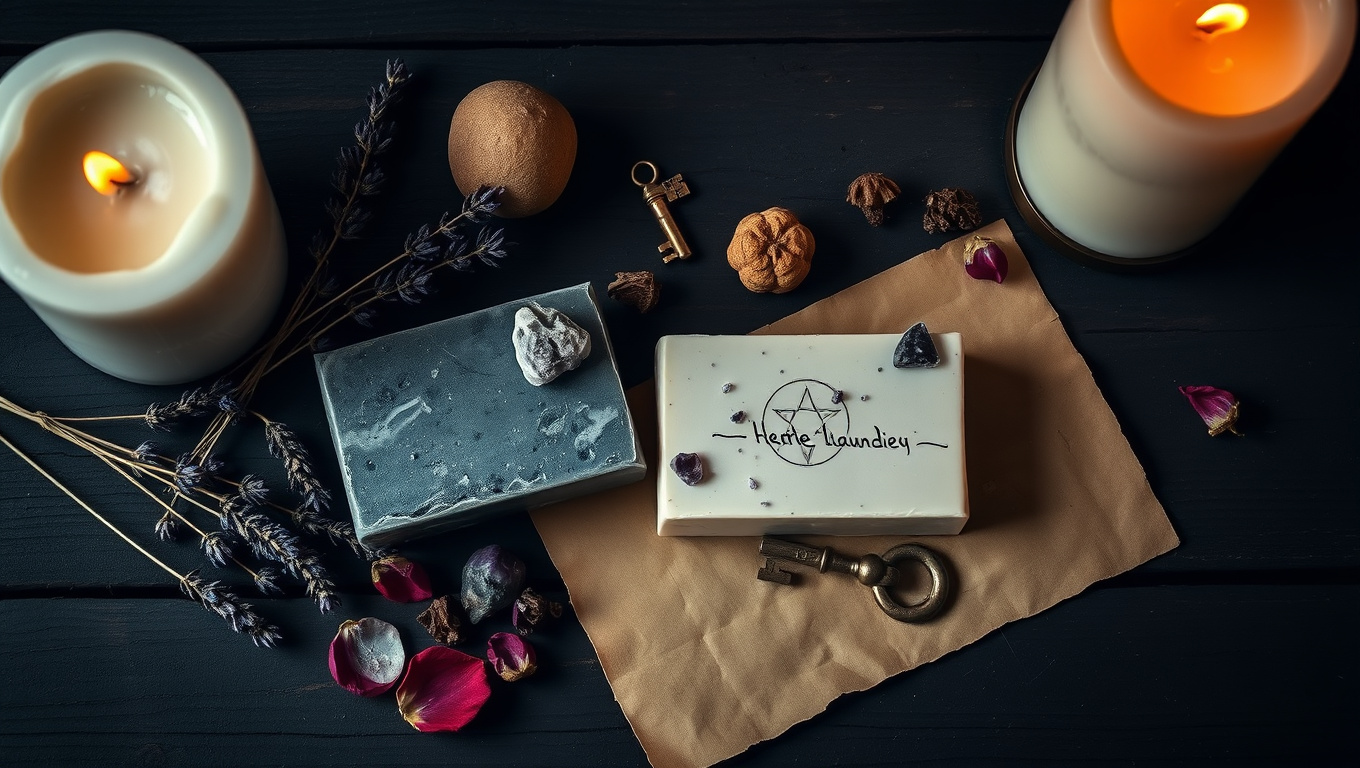
For full moon work — something expansive, rich, and deeply aromatic — the Triple Moon Goddess Natural Witch Ritual Bar Soap from Spellbound Grove is made exactly with this in mind. It carries lavender, frankincense, myrrh, and vanilla — a combination that sits somewhere between soft and sacred, floral and warm. The scent is described as a light fragrance of flowers and powder, and it is crafted specifically for moon baths, spiritual cleansings, and moments of honoring your own cyclical nature. There is an amethyst adornment on the bar, which adds a tactile, visual element that makes it feel genuinely ceremonial without being theatrical about it.
For work around Hecate specifically — for those drawn to the Crone energy, to threshold work, to the deeper mysteries of the triple moon — the Goddess Hecate Natural Handmade Witch Ritual Bar Soap carries myrrh, cypress, lavender, jasmine, and amber, with an antique key embedded on top. Cypress has long been associated in folk tradition with liminal spaces and transitions. Myrrh carries a resinous depth that has been used in sacred and ceremonial contexts across many cultures for centuries. Together, this is a scent profile that feels both grounding and a little otherworldly — exactly right for sitting with the symbol of the crossroads.
Shadow Work, Waning Moons, and the Soap That Fits the Dark Half
Not all moon work is about the peak. Some of the most meaningful ritual practice happens in the waning phase — the Crone’s portion of the cycle — when the work is about releasing, examining what has been stored, and clearing space. This kind of practice is sometimes called shadow work, and it is less glamorous than a full moon ritual but often more transformative.
For this kind of ritual bath, you want something grounding. Earthy. Something that smells of the actual ground, of resin and smoke and bark, rather than sweetness or brightness. The waning moon is not the time for lightness. It is the time for honesty.
Spellbound Grove’s Shadow and Sage Natural Witch Ritual Bar Soap carries vanilla, cedarwood, vetiver, firewood, and black obsidian — a combination that smells genuinely grounded and a little smoky, like a fire burning down to coals. It is crafted specifically for rituals of release and made for use before divination, journaling, or simply washing the heaviness of a hard stretch of time away. That specificity of intention is part of what makes a small-batch ritual soap different from something you grab off a shelf.
Building a Simple Triple Moon Ritual at Home
You do not need an elaborate altar or a collection of tools to work with the triple moon symbol. Here is a simple framework that many people find genuinely useful, regardless of where they land on the spectrum of belief.
Waxing Moon: Set an Intention
In the first half of the lunar cycle, from new moon to full, think about what you want to call in or begin. It might be a creative project, a new habit, a relationship you want to nurture, a skill you want to develop. Write it down somewhere. Even one sentence. Light a candle if you like. Keep it small and honest — vague wishes tend to dissolve. Specific intentions have somewhere to land.
Full Moon: Acknowledge and Receive
On or around the full moon, draw a bath. Use a soap that feels ceremonial to you — something with a scent that actually moves you, made with real ingredients. Sink in. Let yourself be full for a moment, without planning or fixing or worrying. Think about what has arrived since your waxing moon intention. Acknowledge it, even if it arrived in an unexpected form.
This is the heart of the full moon bath ritual. It is not complicated. It is just a practice of noticing.
Waning Moon: Release and Reflect
In the second half of the cycle, from full moon back toward new, think about what is ready to go. Old habits. Resentments you have carried longer than they deserve. Stories about yourself that are no longer true. You do not have to perform a ceremony. You can simply write it down and then set the paper aside, or say it out loud in the bath, or just hold it in mind as you wash.
The act of bathing has always carried the idea of washing something away — across cultures, across centuries, across contexts both sacred and mundane. You do not need to believe in magic for that feeling to be real. Sometimes the ritual is just a permission slip to let something go.
The Symbol on Your Skin: Witchy Apparel and the Triple Moon
For a lot of people, the triple moon symbol is also something they wear. It is a quiet way of carrying a reminder — that you are cyclical, that you contain multitudes, that the dark phase is part of the pattern and not a failure of it. If you are someone who likes to wear your values or your practice in a low-key way, the simple act of putting on something that carries a meaningful symbol can be its own small ritual at the start of a day.
Spellbound Grove’s apparel leans into exactly this kind of quiet enchantment. Nothing loud or costume-like — just thoughtfully designed pieces that feel genuinely wearable, whether you are headed somewhere or just curled up at home with a candle and a book.
The Enduring Pull of the Triple Moon
The triple moon symbol has lasted because it speaks to something real. Cycles are real. The experience of being different at different points in your life is real. The moon’s phases are real and observable and have marked time for humans since long before written history. The symbol ties all of that together into a single image — one that reminds you that you are not supposed to be in one phase forever.
That is a genuinely comforting idea. The Maiden is not better than the Crone. The full moon is not more valuable than the waning crescent. Each has its purpose, its wisdom, its particular kind of power. The triple moon asks you to stop ranking your phases and start inhabiting them.
And a good handmade witch soap — one made with real botanicals, real intention, and real craft — can be part of how you do that. Not because soap is magical in a literal sense, but because sensory ritual helps you arrive in a moment. It slows you down. It asks you to notice. And noticing is the beginning of everything.
Finding Your Ritual Soap at Spellbound Grove
If any of this has you curious, the best way to start is small. Spellbound Grove offers a free soap sample — one handcrafted bar in your choice of scent, with no strings attached. It is a genuinely good way to experience what small-batch, natural soapmaking actually feels like before committing to a full bar. You can also build a sample pack of two bars if you want to explore a couple of different scent profiles side by side.
If you already know what you are looking for — something for a full moon bath, something for shadow work, something aligned with Hecate or the triple goddess — the handmade witch soap collection at Spellbound Grove has been built with exactly these intentions in mind. Each bar is made in small batches, with natural ingredients, and with the kind of attention that you can actually feel when you hold it in your hands.
Take your time. Browse the handcrafted ritual soaps and botanical bath goods at Spellbound Grove, and find a bar that suits wherever you are in your cycle right now. The right one will make itself known.